
Catégories
Nouveau blog
Pourquoi les stations de recharge de VE haute puissance s'appuient-elles sur un ventilateur de refroidissement à air robuste pour la sécurité ?
August 12 , 2026La croissance rapide des véhicules électriques transforme les infrastructures mondiales de transport et d’énergie. Alors que de plus en plus de conducteurs passent des véhicules conventionnels aux véhicules électriques, la demande en infrastructures de recharge fiables et à haute vitesse continue d’augmenter. Les stations de recharge modernes pour véhicules électriques deviennent plus puissantes, plus compactes et plus intelligentes, notamment dans les réseaux de recharge commerciaux, les stations de recharge autoroutières, les installations de recharge pour flottes et les pôles de recharge rapide.
Cependant, une puissance de recharge plus élevée crée également un défi plus complexe en matière de gestion thermique.
Une station de recharge pour véhicules électriques à haute puissance ne fait pas simplement transferer l’électricité du réseau vers un véhicule électrique. Elle effectue de multiples processus de conversion électrique et de contrôle grâce à des modules de puissance, des dispositifs à semi-conducteurs, des redresseurs, des condensateurs, des inductances, des transformateurs, des cartes de contrôle et des systèmes de communication. Au cours de ce processus, une partie de l’énergie électrique est inévitablement convertie en chaleur.
Plus la puissance de recharge est élevée, plus la génération potentielle de chaleur est importante.
Si cette chaleur ne peut pas être évacuée efficacement, la température à l’intérieur de l’armoire de recharge peut augmenter rapidement. Une température excessive peut réduire l’efficacité de conversion de puissance, accélérer le vieillissement des composants, déclencher une protection thermique, réduire les performances de recharge et, dans des situations graves, contribuer à une défaillance du système.
C’est pourquoi les stations de recharge pour véhicules électriques à haute puissance dépendent de plus en plus de systèmes fiables de refroidissement à air forcé. Un ventilateur de refroidissement à air robuste peut déplacer continuellement l’air à travers l’équipement, évacuer la chaleur des composants critiques et aider à maintenir une température de fonctionnement stable.
Pour les fabricants de chargeurs pour véhicules électriques, le choix du bon ventilateur de refroidissement n’est donc pas simplement une décision de conception mécanique. Il constitue une partie importante de la fiabilité de l’équipement, de la gestion thermique et de la sécurité opérationnelle.
Pourquoi la recharge de véhicules électriques à haute puissance génère-t-elle autant de chaleur ?
La raison fondamentale est la conversion de puissance.
Un chargeur de véhicule électrique à haute puissance reçoit l’énergie électrique du réseau et la convertit en tension et en courant requis par la batterie du véhicule. Selon l’architecture du chargeur, le système peut inclure une conversion CA vers CC, une correction du facteur de puissance, une conversion CC, des circuits de commutation, un filtrage et plusieurs systèmes de protection.
Chaque processus de conversion électrique présente un certain degré de perte d’énergie.
Même si un système de recharge atteint une très haute efficacité de conversion, la perte restante peut néanmoins devenir importante lorsque le niveau total de puissance atteint des dizaines ou des centaines de kilowatts.
Par exemple, un faible pourcentage de perte d’énergie dans un système de recharge haute puissance peut se traduire par des centaines ou des milliers de watts de chaleur. Cette chaleur doit être évacuée en continu.
Les principaux composants générateurs de chaleur peuvent inclure les modules de semi-conducteurs de puissance, les dispositifs IGBT ou MOSFET, les redresseurs, les inductances, les transformateurs, les condensateurs, les alimentations électriques et d’autres composants électroniques.
Ces composants sont souvent installés dans un boîtier relativement compact. Par conséquent, la convection naturelle seule peut ne pas fournir une capacité de refroidissement suffisante.
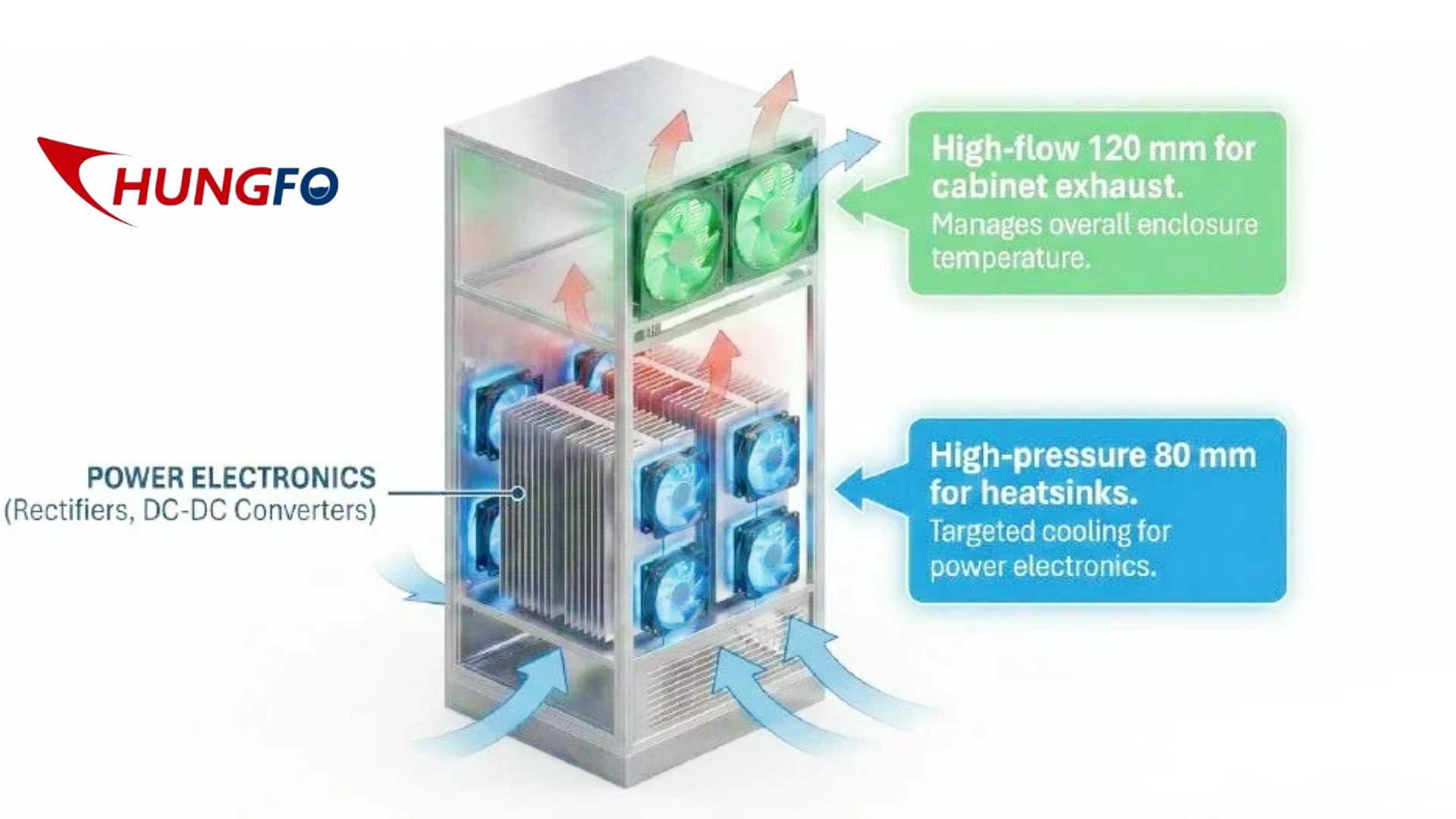
Un ventilateur de refroidissement à air forcé crée un flux d’air contrôlé à travers l’équipement. L’air froid entre par une prise d’air, passe au-dessus ou à travers les composants générateurs de chaleur, puis transporte la chaleur accumulée vers une sortie d’évacuation.
Le principe de base est simple, mais la conception d’un système de circulation d’air efficace pour un chargeur haute puissance nécessite bien plus que l’installation d’un simple ventilateur à l’intérieur de l’armoire.
Pourquoi la gestion thermique est-elle essentielle pour la sécurité de la recharge des véhicules électriques ?
La température a une influence directe sur les performances et la durée de vie des composants électroniques.
Lorsque les dispositifs à semi-conducteurs fonctionnent à des températures excessivement élevées, leurs caractéristiques électriques peuvent changer et leur fiabilité à long terme peut diminuer. Les condensateurs, les matériaux isolants, les connecteurs et d’autres composants peuvent également subir un vieillissement accéléré sous une contrainte thermique prolongée.
Dans une station de recharge haute puissance, plusieurs composants peuvent fonctionner simultanément. Si une partie du système devient excessivement chaude, les composants environnants peuvent également être affectés.
Cela crée une réaction thermique en chaîne potentielle.
Par exemple, un débit d’air insuffisant peut amener un module de puissance à fonctionner à une température plus élevée. L’augmentation de température peut accroître la contrainte thermique et réduire l’efficacité. La diminution de l’efficacité peut entraîner une génération supplémentaire de chaleur, ce qui augmente encore la température.
Un système de refroidissement correctement conçu interrompt ce cycle en évacuant continuellement la chaleur.
C’est l’une des raisons pour lesquelles la gestion thermique doit être prise en compte dès la phase initiale de conception d’une station de recharge pour véhicules électriques plutôt que traitée comme une considération secondaire.
Pourquoi un ventilateur de refroidissement à air robuste est-il une solution pratique ?
Il existe plusieurs approches de gestion thermique, notamment la convection naturelle, le refroidissement liquide, les caloducs et le refroidissement à air forcé.
Pour de nombreux systèmes de recharge, le refroidissement à air forcé reste une solution attrayante grâce à sa structure relativement simple, ses performances évolutives et sa compatibilité avec différents modèles d’armoires.
Un ventilateur de refroidissement robuste peut générer en continu un flux d’air sans nécessiter un circuit de refroidissement complexe.
Il peut également être intégré à des capteurs de température et à des systèmes de contrôle afin que le débit d’air puisse être ajusté en fonction de la charge thermique réelle.
Par exemple, lorsque la station de recharge fonctionne à une charge relativement faible, le ventilateur peut fonctionner à une vitesse réduite. Lorsque la puissance de recharge augmente et que les températures internes s’élèvent, la vitesse du ventilateur peut augmenter en conséquence.
Cela crée un système de refroidissement dynamique capable d’équilibrer les performances thermiques, le bruit et la consommation d’énergie.
Cependant, tous les ventilateurs de refroidissement ne conviennent pas aux applications de recharge de véhicules électriques à haute puissance.
Le ventilateur doit être sélectionné en fonction des conditions de fonctionnement réelles et de la résistance au flux d’air de l’équipement.
Pourquoi le débit d’air et la pression statique sont-ils tous deux importants ?
L’une des erreurs les plus courantes lors de la sélection d’un ventilateur de refroidissement est de se concentrer uniquement sur le débit d’air maximal.
Le débit d’air est important car il détermine la quantité d’air que le ventilateur peut déplacer. Cependant, la valeur du débit d’air indiquée dans une spécification produit est souvent mesurée dans des conditions spécifiques, telles qu’un fonctionnement à air libre.
L’environnement de fonctionnement réel à l’intérieur d’une armoire de recharge pour véhicules électriques peut être considérablement différent.
L’air peut devoir passer à travers des grilles de protection, des filtres, des dissipateurs thermiques, des modules de puissance, des conduits et des ouvertures étroites. Chacune de ces structures crée une résistance.
Le ventilateur doit générer une pression statique suffisante pour surmonter cette résistance.
Par conséquent, le débit d'air réel fourni par un ventilateur dépend de l'interaction entre la courbe de performance du ventilateur et la courbe de résistance du système.
Un ventilateur avec une très grande valeur de débit d'air en air libre ne fournit pas nécessairement les meilleures performances de refroidissement lorsqu'il est installé dans un boîtier restrictif.
Cela est particulièrement important pour les équipements de recharge haute puissance, car la structure interne peut être densément agencée.
Les ingénieurs doivent donc évaluer à la fois le débit d'air et la pression statique lors de la sélection d'une solution de refroidissement.
Comment la direction du flux d'air affecte-t-elle le refroidissement des chargeurs de VE ?
La direction du flux d'air est un autre facteur de conception essentiel.
Un ventilateur de refroidissement peut être utilisé comme ventilateur d'admission ou ventilateur d'extraction selon l'architecture du boîtier.
Une configuration d'admission introduit de l'air extérieur plus frais dans l'enceinte. Une configuration d'extraction évacue l'air chauffé de l'enceinte.
Dans certains systèmes, plusieurs ventilateurs peuvent être utilisés pour créer un trajet de flux d'air contrôlé.
Par exemple, de l'air plus frais peut entrer par la partie inférieure du boîtier, passer à travers les modules de puissance et les dissipateurs thermiques, puis sortir par la section supérieure.
Cette disposition tire parti de la tendance naturelle de l'air chaud à monter tout en utilisant un flux d'air forcé pour augmenter la capacité globale de refroidissement.
Le flux d'air devrait idéalement traverser les zones qui génèrent le plus de chaleur.
Créer simplement des turbulences à l'intérieur du boîtier ne suffit pas.
L'objectif est d'établir un trajet de flux d'air prévisible depuis l'entrée d'air jusqu'aux composants générant de la chaleur, puis enfin jusqu'à la sortie d'air.
C'est pourquoi l'emplacement des ventilateurs, la conception des conduits, l'emplacement des ouvertures d'aération et la disposition des composants doivent être pris en compte ensemble.
Pourquoi les ventilateurs de refroidissement compacts deviennent-ils de plus en plus importants ?
Les équipements de recharge haute puissance deviennent plus compacts.
Les fabricants souhaitent augmenter la puissance de recharge sans augmenter considérablement la taille physique de l'équipement. Cela entraîne une densité de puissance plus élevée et moins d'espace disponible pour les composants de gestion thermique.
Un ventilateur de refroidissement doit donc fournir un débit d'air suffisant tout en s'intégrant dans une zone d'installation limitée.
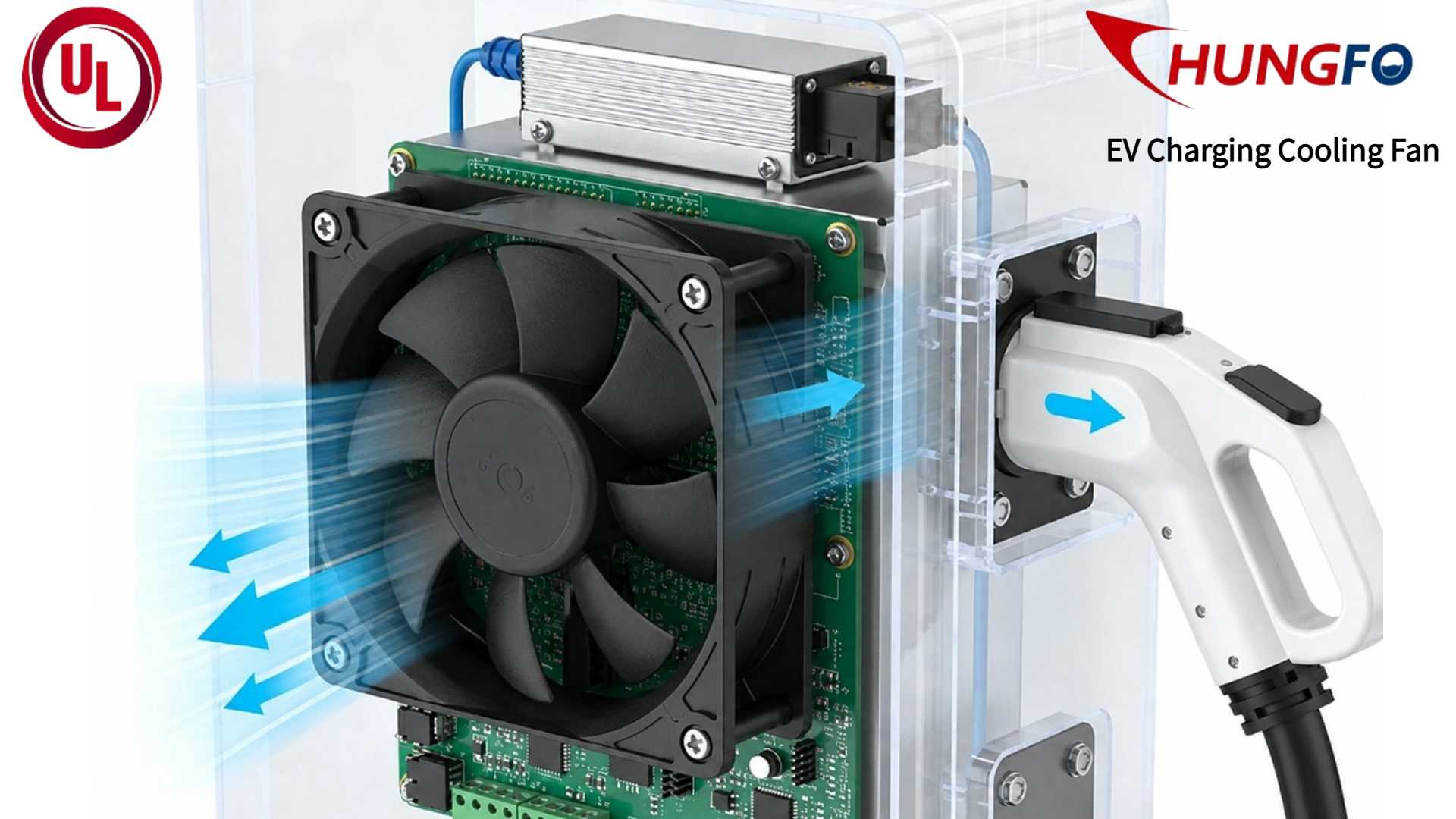
Les ventilateurs axiaux compacts peuvent être utilisés pour un refroidissement localisé autour des composants électroniques de commande et des modules de puissance.
Par exemple, un ventilateur 80x80x25 peut être envisagé lorsqu'un boîtier de recharge nécessite un ventilateur compact avec une empreinte standardisée et une profondeur d'installation limitée.
Un ventilateur de 55 mm peut être utile dans des compartiments électroniques plus petits où un ventilateur plus grand ne pourrait pas entrer.
Pour les applications où la profondeur d'installation est particulièrement limitée, un ventilateur mince de 120peut offrir une autre solution possible en fournissant une zone de circulation d'air plus grande tout en conservant une structure globale plus fine.
Le ventilateur spécifique doit toujours être sélectionné en fonction des exigences réelles du système plutôt que de choisir simplement un modèle selon son nom ou ses dimensions physiques.
Pourquoi l'épaisseur du ventilateur est-elle importante ?
L'épaisseur du ventilateur peut avoir une influence étonnamment importante sur la conception de l'équipement.
Dans un boîtier conventionnel, les ingénieurs peuvent disposer de suffisamment d'espace pour un ventilateur de profondeur standard. Dans les équipements de recharge compacts, cependant, quelques centimètres de profondeur supplémentaire peuvent interférer avec les modules de puissance, le cheminement des câbles, les dissipateurs thermiques ou d'autres composants.
Un ventilateur mince peut réduire l'espace requis par le système de refroidissement.
Cela permet aux ingénieurs d'optimiser l'agencement interne et de créer potentiellement un boîtier de recharge plus compact.
Cependant, la réduction de l'épaisseur du ventilateur ne doit pas se faire au détriment du débit d'air et des performances de pression requis.
L'objectif d'ingénierie est d'obtenir les performances de refroidissement requises dans l'espace disponible.
Par conséquent, les dimensions du ventilateur doivent toujours être évaluées conjointement avec le débit d'air, la pression statique, la vitesse, le bruit et la consommation d'énergie.
Pourquoi le fonctionnement continu est-il une exigence majeure ?
Les stations de recharge pour véhicules électriques peuvent fonctionner pendant de nombreuses heures chaque jour.
Les stations de recharge publiques peuvent subir des cycles de recharge répétés, tandis que les stations de recharge pour flottes commerciales peuvent fonctionner sous de fortes charges pendant des périodes prolongées.
Le ventilateur de refroidissement doit donc pouvoir résister à un fonctionnement répété et continu.
La fiabilité du moteur devient particulièrement importante.
Un moteur à courant continu sans balais est couramment utilisé dans les ventilateurs de refroidissement électroniques modernes, car il ne dépend pas de balais mécaniques traditionnels pour la commutation. Cela peut réduire l'usure liée aux balais et rendre le moteur adapté à un fonctionnement à long terme.
Le système de roulement est tout aussi important.
Le roulement du ventilateur doit supporter une rotation continue tout en maintenant des performances stables. La qualité du roulement peut affecter le bruit, les vibrations, les caractéristiques de démarrage et la durée de vie.
Un ventilateur de haute qualité doit donc être évalué non seulement selon ses performances initiales en matière de débit d'air, mais aussi selon sa stabilité de fonctionnement à long terme.
Comment la température affecte-t-elle les performances du ventilateur ?
La température de fonctionnement autour du ventilateur peut influencer à la fois le moteur et le système de roulement.
Les stations de recharge pour véhicules électriques peuvent être installées à l'intérieur, à l'extérieur, dans des structures de stationnement, le long des autoroutes ou dans des environnements industriels.
Les stations de recharge extérieures peuvent être exposées à des températures estivales élevées, à des températures hivernales basses, à l'humidité, à la poussière et aux cycles de température.
Si le ventilateur de refroidissement fonctionne dans un environnement à haute température, le moteur et le roulement peuvent subir des contraintes thermiques supplémentaires.
Par conséquent, la plage de température de fonctionnement spécifiée doit être prise en compte lors du processus de sélection.
Les conditions environnementales de la station de recharge doivent également être prises en compte pour déterminer le niveau de protection requis et le choix des matériaux.
Un ventilateur destiné à un environnement intérieur contrôlé peut ne pas convenir à une installation extérieure exposée.
Pourquoi la protection contre la poussière est-elle importante ?
La poussière peut s'accumuler à l'intérieur des systèmes de refroidissement au fil du temps.
Lorsque la poussière s'accumule sur les filtres, les dissipateurs thermiques ou les pales du ventilateur, la résistance au flux d'air peut augmenter et les performances de refroidissement peuvent diminuer.
Dans des cas extrêmes, la contamination peut également affecter les composants mécaniques du ventilateur.
Pour cette raison, les concepteurs de stations de recharge doivent tenir compte des conditions environnementales du lieu d'installation.
Si l'équipement de recharge est installé dans un environnement poussiéreux, le système peut nécessiter une filtration appropriée et des procédures de maintenance.
Cependant, les filtres eux-mêmes créent une résistance au flux d'air.
Cela signifie que le ventilateur doit être capable de surmonter la pression statique supplémentaire créée par le filtre.
Encore une fois, cela démontre pourquoi la sélection du ventilateur doit être basée sur l'ensemble du système de circulation d'air plutôt que sur une seule spécification.
Comment le contrôle du ventilateur peut-il améliorer l'efficacité énergétique ?
Faire fonctionner un ventilateur de refroidissement à vitesse maximale en permanence n'est pas toujours nécessaire.
La charge thermique d'une station de recharge pour véhicules électriques peut varier considérablement au cours de la journée.
Lorsque la charge de recharge est faible, la température interne peut rester relativement stable. À ce moment-là, faire fonctionner le ventilateur à vitesse maximale peut consommer de l'énergie inutilement et générer davantage de bruit.
Un système de refroidissement à vitesse variable peut offrir une solution plus efficace.
Des capteurs de température peuvent surveiller les composants critiques ou les températures internes de l'armoire. Le système de contrôle peut ensuite ajuster la vitesse du ventilateur en fonction de la température mesurée.
Le contrôle PWM est une approche couramment utilisée pour contrôler les ventilateurs de refroidissement CC compatibles.
Lorsque la température augmente, le système de contrôle peut augmenter la vitesse du ventilateur et le débit d'air.
Lorsque la température diminue, la vitesse du ventilateur peut être réduite.
Cette approche peut aider à maintenir la stabilité thermique tout en réduisant la consommation d'énergie inutile.
Pourquoi le bruit est-il également un facteur de conception ?
La sécurité et les performances thermiques sont les principaux objectifs d'un système de refroidissement pour station de recharge de véhicules électriques, mais le bruit ne doit pas être négligé.
Les stations de recharge sont de plus en plus installées dans des zones résidentielles, des parkings commerciaux, des immeubles de bureaux, des centres commerciaux et d'autres lieux où le confort acoustique est important.
Un ventilateur fonctionnant à très haute vitesse peut produire davantage de bruit aérodynamique et mécanique.
Des pales de ventilateur mal équilibrées, des problèmes de roulement, des vibrations et un flux d'air turbulent peuvent encore augmenter le bruit.
Par conséquent, la sélection du ventilateur doit tenir compte du débit d'air requis et de la pression statique, ainsi que des performances acoustiques.
Un ventilateur correctement équilibré et un circuit d'écoulement d'air bien conçu peuvent contribuer à réduire les bruits inutiles.
Pour les réseaux de recharge commerciaux, cela peut contribuer à une meilleure expérience utilisateur globale.
Comment la fiabilité du ventilateur affecte-t-elle la maintenance des équipements de recharge ?
Un ventilateur de refroidissement est un composant mobile, ce qui signifie qu'il peut éventuellement subir une usure mécanique.
Si le ventilateur devient bruyant, ralentit ou s'arrête complètement, le système de recharge peut perdre une partie de sa capacité de refroidissement.
Les équipements de recharge modernes peuvent donc intégrer des fonctions de surveillance du ventilateur.
Le système peut surveiller la vitesse du ventilateur ou détecter des conditions de fonctionnement anormales. En cas de défaillance du ventilateur de refroidissement, le chargeur peut générer une alarme, réduire la puissance de recharge ou arrêter le système concerné avant que la température n'atteigne un niveau critique.
Ce type de protection peut améliorer la fiabilité du système.
La maintenance préventive est également importante.
Selon l'environnement d'installation, les filtres et les circuits de ventilation peuvent nécessiter une inspection et un nettoyage réguliers.
Un système de refroidissement bien conçu devrait rendre la maintenance aussi pratique que possible.
Pourquoi les tests des ventilateurs sont-ils importants pour les applications de recharge de véhicules électriques ?
Un ventilateur de refroidissement utilisé dans des équipements de recharge haute puissance doit être testé dans des conditions appropriées.
Les tests importants peuvent inclure des tests de débit d'air, de pression statique, de vitesse, de bruit, de température, de vibration et de performances électriques.
L'équilibrage dynamique est également important, car un déséquilibre du ventilateur peut produire des vibrations.
Des vibrations excessives peuvent affecter le ventilateur lui-même et potentiellement influencer les composants électroniques à proximité.
Pour les fabricants d'équipements de recharge, les tests doivent donc évaluer non seulement si le ventilateur fonctionne, mais aussi s'il peut maintenir des performances stables dans les conditions de fonctionnement prévues.
Cela est particulièrement important lorsque le ventilateur sera utilisé dans un système de recharge commercial où les temps d'arrêt peuvent affecter directement les opérateurs et les utilisateurs.
Comment Guangdong Changfeng peut-il contribuer à la gestion thermique de la recharge des véhicules électriques ?
Guangdong Changfeng se concentre sur la recherche, le développement et la fabrication de ventilateurs de refroidissement pour les applications électroniques et industrielles.
Sa gamme de produits comprend des ventilateurs CC, des ventilateurs CA, des ventilateurs axiaux de refroidissement, des soufflantes centrifuges, des ventilateurs soufflants, des ventilateurs à flux transversal et des ventilateurs sans cadre.
Ces produits peuvent être utilisés dans les équipements de recharge de véhicules électriques, les systèmes de stockage d'énergie, les onduleurs photovoltaïques, les équipements UPS, les armoires d'alimentation et d'autres systèmes électroniques nécessitant un refroidissement à air forcé.
Pour différentes applications, l'entreprise peut fournir différentes configurations de ventilateurs selon la tension, le débit d'air, la pression statique, les dimensions, la vitesse, le bruit et les exigences d'installation.
Guangdong Changfeng dispose également de capacités de production et de test couvrant la conception de produits, le moulage par injection, la production SMT et l'assemblage.
Les équipements de test comprennent des testeurs d'équilibrage dynamique, des équipements de test de pression en tunnel de vent, des chambres haute et basse température, des installations de test acoustique, des équipements de test de corrosion au brouillard salin et d'autres systèmes de test associés.
Ces capacités permettent d'évaluer les performances des ventilateurs de refroidissement sous plusieurs angles.
Pour les fabricants de chargeurs de véhicules électriques, cela est particulièrement précieux car les exigences de gestion thermique varient considérablement entre les différentes architectures de recharge.
Un chargeur résidentiel compact, un chargeur rapide CC commercial et une station de recharge haute puissance sur autoroute peuvent nécessiter des solutions de refroidissement complètement différentes.
Comment les ingénieurs doivent-ils sélectionner un ventilateur de refroidissement pour un chargeur de véhicules électriques haute puissance ?
La première considération doit être la charge thermique totale.
Les ingénieurs doivent comprendre la quantité de chaleur générée par le système de conversion de puissance et la quantité de chaleur qui doit être évacuée.
La deuxième considération doit être le circuit d'écoulement d'air.
L'ingénieur doit identifier les principales sources de résistance, notamment les dissipateurs thermiques, les filtres, les grilles, les conduits et les ouvertures de sortie.
La troisième considération est le débit d'air et la pression statique requis au point de fonctionnement réel.
La quatrième considération est l'espace physique disponible.
Le ventilateur doit s'adapter à la zone d'installation disponible sans interférer avec les modules de puissance, les câbles, les connecteurs ou d'autres composants.
La cinquième considération est la compatibilité électrique.
La tension, le courant, les caractéristiques de démarrage et la méthode de commande doivent correspondre à l'équipement de recharge.
La sixième considération est la fiabilité.
Le moteur, le système de roulement, la plage de température de fonctionnement et la durée de vie prévue doivent répondre aux exigences de l'application.
La septième considération concerne les conditions environnementales.
La poussière, l'humidité, la température et le lieu d'installation peuvent tous influencer la spécification appropriée du ventilateur.
Enfin, les ingénieurs doivent déterminer si le système nécessite un contrôle de vitesse, un contrôle de température ou une détection de défaillance du ventilateur.
Une évaluation complète de ces facteurs peut améliorer considérablement la fiabilité de la solution finale de gestion thermique.
Pourquoi le ventilateur de refroidissement est-il plus qu'un simple composant standard ?
Il peut être tentant de considérer un ventilateur de refroidissement comme un composant courant relativement simple.
Cependant, dans les équipements de recharge de véhicules électriques haute puissance, le ventilateur peut influencer directement les performances thermiques.
Un ventilateur avec un débit d'air insuffisant peut permettre aux températures des composants d'augmenter.
Un ventilateur avec une pression statique insuffisante peut ne pas fournir un débit d'air adéquat à travers un système de dissipation thermique restrictif.
Un ventilateur avec une fiabilité insuffisante peut créer un problème de maintenance.
Un ventilateur avec des dimensions inadaptées peut rendre l'intégration dans l'armoire difficile.
Un ventilateur avec un bruit excessif peut réduire l'adéquation de la station de recharge à certains environnements d'installation.
Par conséquent, le ventilateur de refroidissement doit être considéré comme faisant partie de l'architecture globale de gestion thermique plutôt que comme un composant isolé.
L'avenir de la recharge des véhicules électriques nécessite une meilleure gestion thermique.
La technologie de recharge continuera d'évoluer.
La puissance de recharge augmente, les temps de recharge diminuent et les équipements de recharge deviennent plus compacts.
Parallèlement, les stations de recharge sont intégrées aux systèmes de stockage d'énergie, aux systèmes d'énergie solaire, aux réseaux intelligents et aux plateformes avancées de gestion de l'énergie.
Ces développements continueront d'accroître l'importance de la gestion thermique.
Les futurs systèmes de recharge pourront combiner différentes technologies de refroidissement selon le niveau de puissance et l'application.
Le refroidissement par air restera attrayant pour de nombreuses applications grâce à son architecture relativement simple et à sa facilité de maintenance.
À des niveaux de puissance plus élevés, le refroidissement liquide pourra également être utilisé pour certains composants ou câbles de recharge.
Dans de nombreux systèmes pratiques, cependant, le refroidissement par air forcé continuera à jouer un rôle important dans le refroidissement des composants électroniques de puissance, des armoires de commande et des composants auxiliaires.
L'essentiel n'est pas simplement de choisir un ventilateur plus puissant.
L'objectif est de concevoir un système de gestion thermique efficace dans lequel le ventilateur, le chemin du flux d'air, le dissipateur thermique et la stratégie de contrôle fonctionnent ensemble.
Conclusion
Les stations de recharge de véhicules électriques haute puissance reposent sur une gestion thermique efficace, car de grandes quantités d'énergie électrique sont traitées dans un espace relativement compact.
Les composants de conversion d'énergie génèrent inévitablement de la chaleur, et un fonctionnement continu à haute puissance peut créer des charges thermiques importantes.
Un ventilateur de refroidissement par air robuste fournit une méthode pratique pour déplacer continuellement l'air à travers le système de recharge et transférer la chaleur loin des composants électroniques critiques.
Cependant, choisir le bon ventilateur nécessite plus que de comparer les valeurs maximales de débit d'air.
Les ingénieurs doivent évaluer le débit d'air, la pression statique, les dimensions d'installation, l'épaisseur du ventilateur, la température de fonctionnement, la conception du moteur, la fiabilité des roulements, le bruit, les conditions environnementales et la durée de vie prévue.
Des options compactes telles qu'un ventilateur 80x80x25 peuvent être envisagées pour certains espaces d'installation standardisés. Un ventilateur de 55 mm peut convenir aux petits compartiments électroniques, tandis qu'un ventilateur mince de 120 mm peut être envisagé lorsque la profondeur d'installation est limitée.
Le modèle exact doit toujours être sélectionné en fonction de la résistance réelle du système et des exigences thermiques.
Pour les fabricants de stations de recharge, un système de refroidissement bien conçu peut aider à maintenir des températures stables des composants, améliorer la fiabilité des équipements, prolonger la durée de vie des composants et réduire le risque de défaillances liées à la chaleur.
À mesure que la puissance de recharge des véhicules électriques continue d'augmenter, un refroidissement fiable deviendra encore plus important.
Le ventilateur de refroidissement peut être un composant relativement petit par rapport à l'ensemble de la station de recharge, mais son rôle dans la gestion thermique peut être essentiel.
Pour cette raison, sélectionner un fabricant fiable de ventilateurs de refroidissement et valider le ventilateur dans des conditions de fonctionnement réalistes devrait constituer une partie importante du processus de développement des équipements de recharge de véhicules électriques haute puissance.
FAQ
Pourquoi les stations de recharge de véhicules électriques haute puissance ont-elles besoin de ventilateurs de refroidissement robustes ?
Les stations de recharge de véhicules électriques haute puissance génèrent une chaleur importante car leurs systèmes de conversion d'énergie traitent de grandes quantités d'énergie électrique. Un ventilateur de refroidissement robuste aide à évacuer cette chaleur et à maintenir une température de fonctionnement stable.
Le débit d'air est-il plus important que la pression statique pour les applications de recharge de VE ?
Aucun de ces deux paramètres ne doit être considéré indépendamment. Le débit d'air détermine la quantité d'air pouvant être déplacée, tandis que la pression statique détermine l'efficacité avec laquelle le ventilateur peut surmonter la résistance. Le point de fonctionnement réel doit être pris en compte lors de la sélection du ventilateur.
Quelles sont les causes des températures élevées à l'intérieur d'une armoire de recharge de VE ?
Les sources courantes comprennent les modules de semi-conducteurs de puissance, les redresseurs, les transformateurs, les inductances, les condensateurs, les alimentations à découpage et d'autres composants électriques. Une température ambiante élevée et un débit d'air limité peuvent encore augmenter les températures internes.
Un petit ventilateur peut-il être utilisé à l'intérieur d'une station de recharge de VE haute puissance ?
Oui. De petits ventilateurs peuvent être utilisés pour le refroidissement localisé des cartes de commande, des modules électroniques et d'autres zones où l'espace d'installation est limité. Le ventilateur doit être sélectionné en fonction du débit d'air requis, de la pression statique et de la charge thermique.
À quoi sert couramment un ventilateur 80x80x25 ?
Un ventilateur 80x80x25 est une taille de ventilateur compacte et standardisée qui peut être envisagée pour le refroidissement électronique, les alimentations, les armoires de commande et d'autres applications où l'espace d'installation est limité.
Quand un ventilateur de 55 mm est-il approprié ?
Un ventilateur de 55 mm peut être envisagé pour les équipements électroniques compacts et les zones de refroidissement localisées où un ventilateur plus grand ne peut pas être installé. Les exigences réelles en matière de débit d'air et de pression doivent être vérifiées avant la sélection.
Pourquoi un ingénieur choisirait-il un ventilateur mince de 120 mm ?
Un ventilateur mince de 120 mm peut être utile lorsque la profondeur d'installation disponible est limitée, mais que le système nécessite toujours une zone de débit d'air relativement grande. Il peut aider les ingénieurs à optimiser l'espace de l'armoire tout en maintenant un refroidissement par air forcé.
Les ventilateurs de refroidissement pour recharge de VE peuvent-ils fonctionner en continu ?
Les ventilateurs conçus pour les applications industrielles peuvent être configurés pour un fonctionnement continu à long terme. Cependant, la durée de vie réelle dépend du moteur, du système de roulement, de la température de fonctionnement, de la charge, du niveau de poussière et d'autres facteurs environnementaux.
Comment le contrôle de la vitesse du ventilateur peut-il améliorer le refroidissement du chargeur de VE ?
Le contrôle de la vitesse du ventilateur permet au système de refroidissement de répondre à la charge thermique réelle. Le ventilateur peut fonctionner à une vitesse plus faible lorsque les températures sont basses et augmenter sa vitesse lorsque la température monte. Cela peut aider à équilibrer les performances de refroidissement, la consommation d'énergie et le bruit.
Le bruit du ventilateur est-il important pour les stations de recharge de VE ?
Oui. Les stations de recharge de VE peuvent être installées dans des environnements résidentiels, commerciaux et publics. Un bruit excessif du ventilateur peut affecter négativement l'expérience utilisateur, c'est pourquoi le débit d'air, la pression statique et les performances acoustiques doivent être évalués ensemble.
Pourquoi la pression statique est-elle importante lorsque le chargeur utilise un filtre ?
Les filtres limitent le débit d'air. Le ventilateur doit générer une pression statique suffisante pour surmonter la résistance créée par le filtre et les autres composants du chemin d'écoulement de l'air. Lorsque le filtre devient encrassé, la résistance peut encore augmenter.
Comment la poussière affecte-t-elle le refroidissement du chargeur de VE ?
La poussière peut s'accumuler sur les filtres, les dissipateurs thermiques et les composants du ventilateur. Cela peut augmenter la résistance au débit d'air et réduire l'efficacité du refroidissement. Une filtration et une maintenance appropriées sont donc importantes pour les stations de recharge installées dans des environnements poussiéreux.
Quelles certifications possède Guangdong Changfeng ?
Le cadre de certification de Guangdong Changfeng relatif à la fabrication et aux produits comprend ISO9001, ISO14000, CE, UL, TÜV, CCC, SGS, RoHS, REACH et IATF16949.
L'entreprise possède également l'homologation de produit UL GPWV2.E311396. Le périmètre de certification peut varier selon le produit spécifique, le modèle et les exigences de certification applicables. Les clients doivent donc confirmer les documents de certification correspondants pour le produit acheté.
Pourquoi les fabricants de chargeurs de VE devraient-ils travailler avec un fabricant expérimenté de ventilateurs de refroidissement ?
Un fabricant expérimenté de ventilateurs de refroidissement peut aider les ingénieurs à évaluer ensemble le débit d'air, la pression statique, les dimensions, les caractéristiques du moteur, la sélection des roulements, le bruit, la température de fonctionnement et d'autres paramètres. Cela peut faciliter le développement d'une solution de refroidissement adaptée aux exigences thermiques réelles du système de recharge.
Que doivent fournir les clients lorsqu'ils demandent un ventilateur de refroidissement pour recharge de VE ?
Les informations utiles comprennent la tension d'entrée, le débit d'air requis, la pression statique, les dimensions d'installation, l'épaisseur disponible, la température de fonctionnement, les exigences de bruit, la durée de fonctionnement prévue, la méthode de contrôle et l'environnement d'application.
Plus les informations sur l'application sont complètes, plus le ventilateur de refroidissement peut être adapté précisément au système de recharge réel.