Catégories
Nouveau blog
Comment les petits ventilateurs centrifuges CC résolvent-ils les problèmes de flux d'air et de thermique dans les appareils CPAP et les appareils électroménagers compacts ?
September 14 , 2026Les appareils compacts modernes sont de plus en plus petits, silencieux, intelligents et multifonctionnels. Un appareil CPAP, un purificateur d'air compact, un diffuseur d'arômes, un dispositif de traitement de l'air personnel, un système de refroidissement électronique ou un petit appareil électroménager peuvent occuper très peu de place sur un bureau ou une table de chevet, mais leurs composants internes génèrent tout de même de la chaleur et nécessitent un flux d'air contrôlé.
Cela pose un défi d'ingénierie important : comment un petit appareil peut-il brasser suffisamment d'air dans un espace interne limité tout en maintenant une température, un niveau sonore, une consommation d'énergie, une fiabilité et une taille de produit acceptables ?
Pour de nombreuses applications, unSouffleur centrifuge compact à courant continuoffre une solution efficace.
Contrairement à un ventilateur axial classique à flux libre, un ventilateur centrifuge est conçu pour diriger le flux d'air de manière plus précise et générer une pression statique utile dans un format compact. Cette technologie s'avère donc particulièrement précieuse lorsque l'air doit traverser des conduits, des filtres, des passages étroits, des sources de chaleur ou d'autres éléments créant une résistance à l'écoulement.
Dans les appareils CPAP, le flux d'air et la pression sont des éléments fondamentaux de leur architecture. Dans les appareils électroménagers compacts, cette même technologie de flux d'air peut également servir au refroidissement, à la ventilation, à la filtration, à la circulation de l'air, à la gestion des odeurs ou à la dissipation de la chaleur.
Pour les fabricants, le choix d'un ventilateur miniature adapté ne se résume donc pas à opter pour un modèle à haut régime. Le véritable défi technique consiste à optimiser le débit d'air, la pression, le niveau sonore, les performances thermiques, la consommation électrique, les dimensions, les exigences de contrôle et la durée de vie prévue.
Pourquoi la gestion thermique devient de plus en plus importante dans les appareils compacts
La tendance à la miniaturisation des appareils électroménagers a engendré une contradiction technique majeure.
Les consommateurs recherchent des produits compacts, mais les composants électroniques qu'ils contiennent continuent de générer de la chaleur. Moteurs, cartes de contrôle, alimentations, capteurs, éléments chauffants, circuits de charge, processeurs, modules LED et autres composants électroniques contribuent tous à l'élévation de la température interne.
Lorsqu'un produit devient plus petit, l'espace disponible pour la convection naturelle diminue également.
Un appareil électroménager de grande taille possède un volume interne suffisant pour que la chaleur se répartisse naturellement. Un appareil compact ne bénéficie pas de cet avantage. La chaleur peut s'accumuler autour de certains composants et créer des points chauds localisés.
Ces points chauds peuvent influencer la durée de vie des composants, la stabilité électrique, la température du boîtier en plastique, les performances acoustiques et la fiabilité globale du produit.
Un petit ventilateur centrifuge à courant continu peut contribuer à résoudre ce problème en établissant un flux d'air contrôlé.
Au lieu de se fier uniquement à la ventilation passive, le concepteur peut utiliser le ventilateur pour aspirer l'air à partir d'un emplacement d'entrée spécifique et le rejeter vers une source de chaleur ou un canal de sortie spécifique.
Ceci est particulièrement utile lorsque la structure interne est complexe.
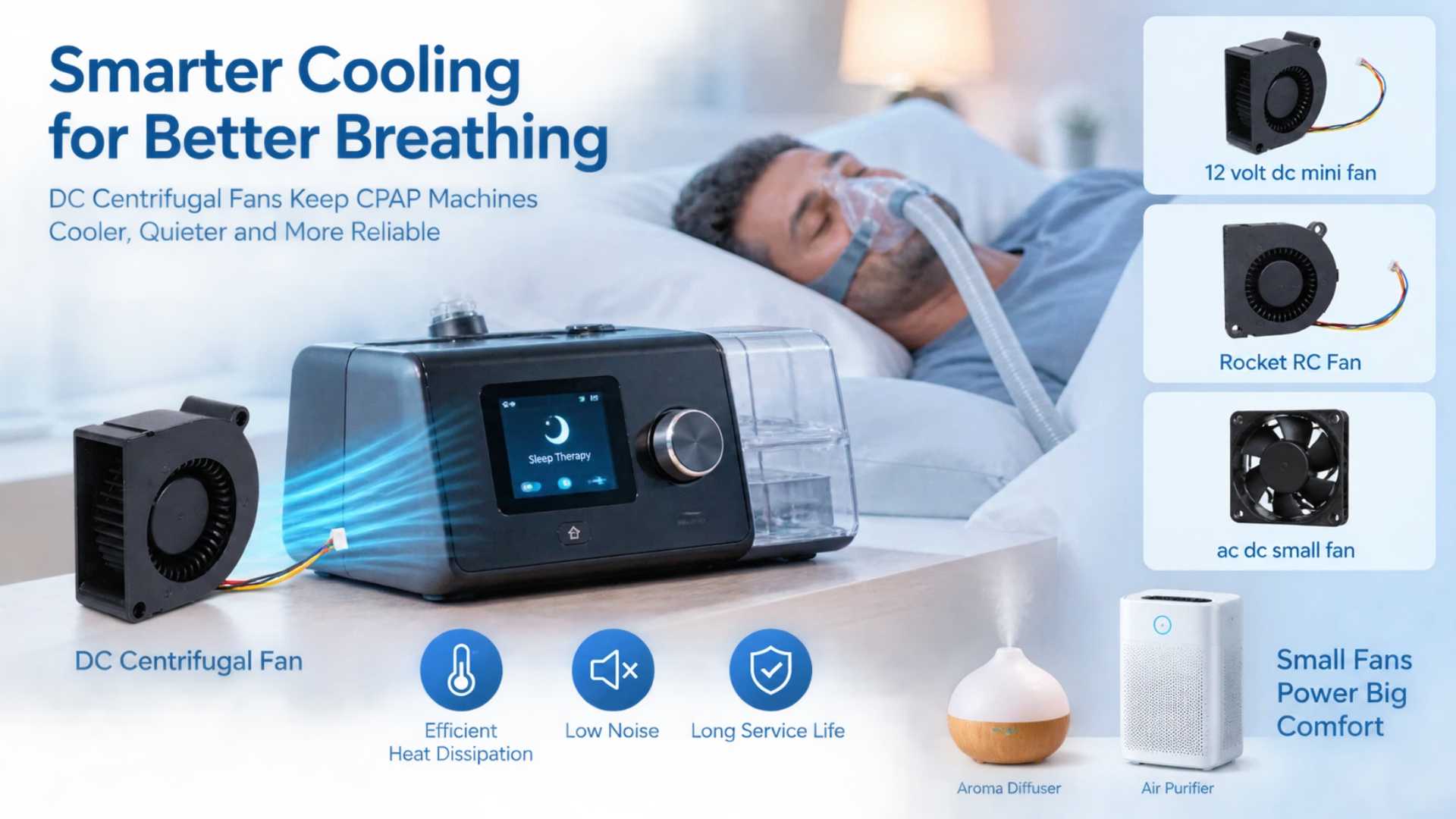
Par exemple, un purificateur d'air peut contenir un filtre, un moteur, une carte de commande, une alimentation électrique, un capteur et une sortie d'air dans un boîtier relativement petit. Un diffuseur d'arômes peut contenir un circuit de commande, un système de brumisation, des composants d'éclairage et un conduit d'air compact. Un appareil CPAP peut contenir un ventilateur, des composants électroniques de commande, des capteurs de pression, des composants d'humidification et des raccords de tuyauterie.
Chaque application a des exigences différentes en matière de flux d'air, mais elles partagent le même problème d'ingénierie fondamental : la chaleur et l'air doivent être gérés à l'intérieur d'un volume restreint.
Pourquoi un ventilateur centrifuge peut être plus adapté qu'un ventilateur axial standard
Ventilateurs axiauxsont excellentes pour les applications où l'air peut circuler relativement librement dans un espace ouvert.
Cependant, de nombreux produits compacts ne permettent pas une circulation d'air optimale.
L'air peut devoir traverser un conduit étroit, un filtre, une grille, un échangeur de chaleur, une enceinte ou un système de tuyauterie. Chacun de ces composants crée une résistance.
Un ventilateur centrifuge modifie la direction du flux d'air grâce à sa roue et à son carter. Cette structure lui permet de générer un flux d'air plus dirigé et une pression statique utile.
Cette caractéristique est particulièrement importante pour les systèmes CPAP.
Un appareil CPAP ne se contente pas de créer un courant d'air à l'intérieur de l'enceinte. Il doit fournir un flux d'air contrôlé via un circuit dédié. Le ventilateur devient donc un élément essentiel du système de pression et de débit d'air.
Les ouvrages techniques traitant de la conception des appareils CPAP identifient les ventilateurs centrifuges comme une architecture appropriée en raison de leur volume compact et de leur capacité à produire le débit d'air requis malgré la résistance du système.
Le même principe peut être appliqué aux appareils électroménagers compacts.
Si un purificateur d'air est équipé d'un filtre restrictif, le ventilateur doit maintenir le débit d'air malgré la chute de pression créée par le filtre.
Si un diffuseur d'arômes utilise un canal interne étroit, la source de flux d'air doit maintenir un débit suffisant à travers ce canal.
Si un boîtier électronique compact contient un dissipateur thermique et des ouvertures de ventilation limitées, le ventilateur de refroidissement doit surmonter la résistance créée par le boîtier.
Par conséquent, le choix d'un ventilateur doit toujours prendre en compte le système dans son ensemble et non pas uniquement le flux d'air.
Quels sont les problèmes thermiques qui peuvent survenir avec les appareils CPAP ?
Les appareils CPAP sont particulièrement intéressants car le composant générateur de flux d'air peut lui-même générer de la chaleur.
Un moteur à courant continu convertit l'énergie électrique en énergie mécanique, mais toute l'énergie d'entrée n'est pas transformée en énergie mécanique utile. Une partie est dissipée sous forme de chaleur.
Le ventilateur peut donc devenir une source de chaleur à l'intérieur de l'enceinte.
De plus, la compression et la mise sous pression peuvent augmenter la température de l'air en mouvement. Des recherches sur la thermodynamique de la PPC (pression positive continue) indiquent que l'inefficacité du ventilateur peut générer de la chaleur autour de celui-ci et que la compression de l'air peut également contribuer à l'augmentation de la température du flux d'air.
Cela soulève plusieurs considérations thermiques.
La première est la température du moteur.
Si un ventilateur fonctionne en continu pendant de nombreuses heures, les pertes du moteur peuvent progressivement augmenter sa température interne. Un moteur qui semble convenir lors d'un court test en laboratoire peut se comporter différemment après une utilisation prolongée.
La seconde est l'électronique de contrôle.
Le ventilateur peut fonctionner avec un variateur de moteur, un système de capteurs, un circuit de conversion de puissance ou une carte de commande. Ces composants électroniques génèrent également de la chaleur.
Le troisième élément est l'enceinte qui l'entoure.
Si le ventilateur est installé dans un boîtier en plastique compact à ventilation limitée, de la chaleur risque de s'accumuler autour du moteur et des composants électroniques.
Le quatrième facteur est la température du flux d'air.
Le flux d'air généré par le ventilateur peut influencer la température des composants en aval et l'air distribué par le système.
C’est pourquoi la gestion thermique doit être envisagée conjointement avec la conception des flux d’air plutôt que traitée comme une question totalement distincte.
Un fonctionnement continu exige des performances thermiques stables
Un appareil CPAP est généralement conçu pour fonctionner pendant de longues périodes durant le sommeil.
Cela signifie que la conception thermique ne peut pas se baser uniquement sur un test de courte durée.
Un ventilateur ou une soufflerie peut bien fonctionner pendant dix minutes, mais le comportement de la température après plusieurs heures peut être très différent.
Avec la hausse des températures, plusieurs choses peuvent changer.
La résistance des enroulements du moteur peut augmenter.
Les conditions de roulement peuvent changer.
Les composants électroniques peuvent subir des contraintes thermiques supplémentaires.
Les matières plastiques peuvent supporter des températures plus élevées.
Les caractéristiques de lubrification peuvent changer.
Les caractéristiques sonores peuvent également changer en fonction des modifications des composants mécaniques et des conditions d'écoulement de l'air.
Pour les fabricants, la bonne approche consiste donc à évaluer le ventilateur dans des conditions de fonctionnement réalistes.
Les tests doivent prendre en compte la tension, le débit d'air, la pression statique, la température ambiante, la durée de fonctionnement, l'orientation d'installation, la structure du boîtier et la résistance réelle au flux d'air.
Les spécifications d'un ventilateur ne doivent pas être évaluées indépendamment du produit final.
Pourquoi un faible niveau sonore est important dans les applications CPAP
La gestion thermique ne représente qu'un aspect du problème des ventilateurs CPAP.
Le bruit est tout aussi important.
Un appareil CPAP est souvent utilisé pendant de nombreuses heures à côté du lit de l'utilisateur. Même une légère augmentation du bruit mécanique ou aérodynamique peut devenir perceptible dans une chambre silencieuse.
Le ventilateur doit donc équilibrer pression, débit d'air, vitesse, efficacité et performances acoustiques.
Une vitesse plus élevée peut générer un débit d'air et une pression plus importants, mais elle peut également accroître le bruit aérodynamique et le bruit mécanique.
L'objectif n'est pas simplement de sélectionner le moteur le plus rapide.
En revanche, la géométrie de la turbine, la conception du moteur, la structure du boîtier, le canal d'écoulement de l'air, le système de roulement, la méthode de contrôle de la vitesse et la conception de l'installation doivent tous fonctionner de concert.
C’est l’une des raisons pour lesquelles les ventilateurs centrifuges compacts utilisés pour des applications exigeantes peuvent être considérablement plus sophistiqués que les ventilateurs de refroidissement miniatures ordinaires.
Relation entre le débit d'air, la pression et la chaleur
Une erreur fréquente lors du choix d'un ventilateur est de se concentrer uniquement sur le CFM.
Le débit d'air mesuré sous une résistance nulle ou très faible ne représente pas nécessairement le débit d'air que le ventilateur fournira à l'intérieur du produit fini.
Le système peut contenir des filtres, des conduits, des grilles, des tubes, des dissipateurs thermiques, des coudes, des vannes ou d'autres restrictions.
À mesure que la résistance augmente, le point de fonctionnement du ventilateur change.
C’est pourquoi les ingénieurs doivent examiner la courbe pression-débit et identifier le point de fonctionnement réel.
Un ventilateur doté d'un débit d'air libre élevé peut avoir de mauvaises performances dans un système restrictif.
À l'inverse, un ventilateur doté d'une capacité de pression appropriée peut maintenir un débit d'air utile même lorsque le système devient plus résistant.
Les performances thermiques sont liées à cette relation.
Si un ventilateur est contraint de fonctionner de manière inefficace parce qu'il est mal adapté au système, la consommation électrique peut augmenter tandis que le débit d'air utile reste insuffisant.
Cela peut générer une chaleur inutile.
Le choix approprié du ventilateur peut donc contribuer à l'efficacité thermique en améliorant le rapport entre la consommation électrique et le débit d'air utile.
La conception compacte des appareils CPAP crée un défi en matière d'emballage
L'espace est un autre facteur important à prendre en compte.
Les appareils CPAP sont conçus pour être suffisamment portables pour une utilisation à domicile et, dans de nombreux cas, pour les voyages.
Un ventilateur doit donc pouvoir s'insérer dans un volume interne limité.
Le concepteur doit prendre en compte les dimensions extérieures du ventilateur, la position de l'entrée, la position de la sortie, les trous de fixation, la disposition des câbles, l'interface de commande et le dégagement environnant.
Le ventilateur ne peut être évalué uniquement comme un composant indépendant.
Il doit s'intégrer à l'architecture mécanique complète.
Une conception centrifuge compacte peut présenter un avantage car le flux d'air peut être redirigé à travers un boîtier plutôt que de nécessiter un grand passage axial ouvert pour le flux d'air.
Cela peut faciliter la tâche des ingénieurs pour la création de canaux de circulation d'air internes compacts.
Qu'en est-il des purificateurs d'air ?
Les mêmes principes thermiques et de circulation d'air s'appliquent aux petits purificateurs d'air.
Un purificateur d'air compact peut contenir un système de filtration qui crée une résistance importante au flux d'air.
Parallèlement, le moteur et les composants électroniques produisent de la chaleur.
Le ventilateur doit donc remplir deux fonctions au niveau du système.
Il doit permettre à l'air de traverser le filtre et contribuer à maintenir la circulation souhaitée.
Il doit également assurer la ventilation des composants internes lorsque l'architecture du produit l'exige.
Les purificateurs d'air compacts modernes privilégient souvent le fonctionnement silencieux. Par exemple, les purificateurs d'air compacts destinés aux particuliers peuvent proposer plusieurs vitesses de ventilation et des modes de fonctionnement à faible niveau sonore, illustrant ainsi le lien étroit entre le contrôle du flux d'air et les performances acoustiques dans les produits ménagers.
Un ventilateur centrifuge miniature correctement sélectionné peut s'avérer particulièrement utile lorsque le produit nécessite un flux d'air dirigé à travers une structure de filtre ou de conduit confinée.
Les diffuseurs d'arômes nécessitent également un flux d'air contrôlé.
Les diffuseurs d'arômes sont un autre exemple d'appareil compact dans lequel le flux d'air peut influencer les performances du produit.
Un diffuseur de parfum peut contenir un petit ventilateur ou un système de ventilation pour répartir le parfum dans l'environnement.
Étant donné que le produit est généralement placé dans des chambres, des bureaux, des salons ou d'autres espaces calmes, un bruit excessif peut nuire à l'expérience utilisateur.
La taille physique d'un diffuseur d'arômes limite également l'espace disponible pour le moteur et le canal de circulation d'air.
Certains diffuseurs d'arômes commerciaux utilisent une entrée DC12V et des structures de flux d'air internes compactes, illustrant l'importance des composants de flux d'air miniatures dans cette catégorie de produits.
Pour ce type d'application, le ventilateur ne nécessite pas forcément une pression extrêmement élevée. Les ingénieurs privilégieront plutôt des dimensions compactes, un flux d'air stable, une faible consommation d'énergie, un faible niveau sonore et une longue durée de vie.
Pourquoi un ventilateur 12 volts CC peut être utile dans les produits compacts
UNVentilateur 12 volts CCpeut s'avérer intéressant pour de nombreux produits basse tension car le 12V est déjà largement utilisé dans les systèmes électroniques et embarqués.
Cela peut simplifier l'intégration avec les architectures d'alimentation existantes.
Cependant, la tension à elle seule ne permet pas de déterminer si un ventilateur est adapté.
Les ingénieurs doivent évaluer :
Tension nominale
Plage de tension de fonctionnement
Consommation de courant
Vitesse
Flux d'air
Pression statique
Bruit
structure porteuse
Température de fonctionnement
espérance de vie
Protection du moteur
Configuration du connecteur
Dimensions de montage
Méthode de contrôle
Pour un système CPAP ou tout autre produit critique, ces paramètres doivent être évalués en fonction des exigences réelles de l'application.
Un petit ventilateur doté d'une tension nominale pratique peut néanmoins s'avérer inadapté si sa capacité de pression, son niveau sonore, sa plage de température ou sa fiabilité ne correspondent pas à l'application.
Comment un petit ventilateur contribue à réduire les points chauds internes
L'avantage thermique le plus concret d'un ventilateur miniature réside souvent dans la réduction des points chauds localisés.
Imaginez un boîtier compact contenant un circuit de commande de moteur et un circuit d'alimentation.
Sans ventilation forcée, la chaleur risque de rester concentrée autour des composants électroniques.
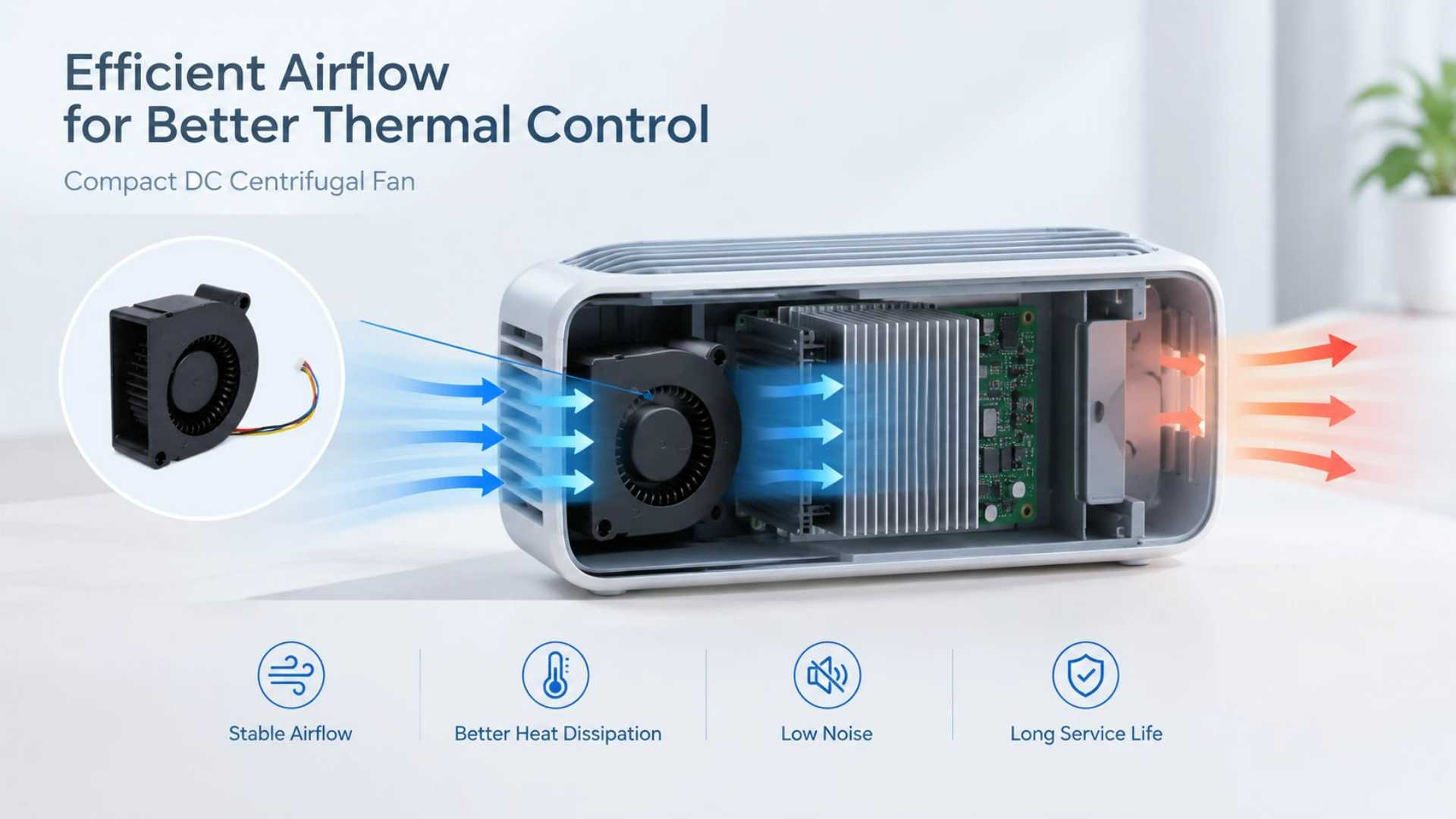
Grâce à un circuit d'air correctement conçu, l'air ambiant plus frais peut être introduit dans l'enceinte tandis que l'air plus chaud est dirigé vers une sortie.
Le ventilateur peut ainsi établir un chemin thermique reproductible.
L'important est que le ventilateur ne se contente pas de faire circuler de l'air chaud de manière aléatoire à l'intérieur de l'enceinte.
Le flux d'air doit être conçu intentionnellement.
L'air doit entrer par un endroit relativement frais, passer au-dessus ou à proximité des composants générateurs de chaleur concernés, et sortir par une sortie appropriée.
C’est là que la conception du flux d’air au niveau du système devient importante.
Rôle du boîtier du ventilateur et de la conception du canal de flux d'air
Le carter autour d'un ventilateur centrifuge n'est pas seulement protecteur.
Il influence la direction du flux d'air, la génération de pression, les fuites, le bruit et l'efficacité du système.
Des canaux d'écoulement d'air mal conçus peuvent créer des turbulences et des pertes de pression inutiles.
Les virages serrés, les changements de section brusques, les passages étroits et les sorties mal positionnées peuvent tous réduire le flux d'air efficace.
Par conséquent, le ventilateur et l'enceinte du produit doivent être considérés comme un seul système de flux d'air.
Un fabricant peut choisir un ventilateur haute performance, mais si le conduit du produit est mal conçu, les performances finales peuvent tout de même être décevantes.
C’est pourquoi les tests de prototypes sont essentiels.
Pourquoi la technologie BLDC est intéressante pour une exploitation à long terme
La technologie des moteurs CC sans balais est largement utilisée dans les produits de ventilation compacts car elle permet un fonctionnement efficace et contrôlable sans la commutation mécanique associée aux moteurs à balais traditionnels.
Pour les applications nécessitant un fonctionnement prolongé, la possibilité de contrôler la vitesse électroniquement peut également s'avérer précieuse.
Un contrôleur peut ajuster la vitesse du ventilateur en fonction des besoins du système.
Par exemple, un purificateur d'air peut augmenter le débit d'air lorsque la résistance du filtre ou les exigences en matière de qualité de l'air changent.
Un système de refroidissement compact peut réduire sa vitesse lorsque la température interne est basse et l'augmenter lorsque la température monte.
Un système CPAP peut utiliser un fonctionnement contrôlé du ventilateur dans le cadre de son architecture de régulation de pression.
Certains modèles de ventilateurs CPAP utilisent des moteurs CC sans balais et une commande électronique de la vitesse, car un contrôle précis est important pour cette application.
Pourquoi le choix d'un ventilateur doit commencer par le système
Le meilleur ventilateur n'est pas forcément celui qui a le débit d'air le plus élevé.
Le meilleur ventilateur est celui qui offre les performances requises au point de fonctionnement réel du système.
Les ingénieurs devraient commencer par définir l'application.
Quel débit d'air est nécessaire ?
Quelles pressions faut-il surmonter ?
De quel espace disposez-vous ?
Quelle est la température ambiante prévue ?
Combien de temps le produit fonctionnera-t-il en continu ?
Quel niveau sonore est acceptable ?
Quelle est la tension disponible ?
Quel signal de commande est requis ?
Quel objectif de fiabilité doit être atteint ?
Quelles certifications et quels documents sont requis ?
Une fois ces paramètres connus, le ventilateur peut être sélectionné de manière plus scientifique.
Petits ventilateurs dans d'autres applications électroniques et domestiques
La demande en solutions miniatures de flux d'air va bien au-delà des appareils CPAP.
Les petits ventilateurs et souffleurs de refroidissement sont de plus en plus utilisés dans les systèmes de contrôle électronique, les équipements de communication, les alimentations électriques, les équipements de charge, les instruments de laboratoire, les appareils ménagers et les appareils portables.
Un appareil compact peut nécessiter un ventilateur pour un refroidissement direct.
Un autre peut nécessiter une circulation d'air pour éviter la condensation.
Une autre possibilité est d'utiliser la circulation de l'air pour diffuser le parfum.
Un autre peut nécessiter une ventilation autour de l'alimentation électrique.
Une autre option consiste à utiliser un ventilateur pour faire passer l'air à travers un filtre.
Ces applications ont des exigences différentes en matière de flux d'air, mais le principe de conception sous-jacent est similaire.
Le ventilateur doit créer le flux d'air adéquat à la pression appropriée tout en fonctionnant de manière fiable dans l'espace disponible.
Où se situe un ventilateur de fusée radiocommandé sur le marché plus vaste des ventilateurs miniatures ?
L'expression « ventilateur Rocket RC » est associée aux exigences de flux d'air et de refroidissement compactes des petits équipements et des applications liées au modélisme.
La leçon importante en matière d'ingénierie ne réside pas dans le nom d'une catégorie de produits spécifique, mais dans le fait que les petits appareils peuvent tout de même avoir des exigences thermiques élevées.
Les équipements radiocommandés, les modules électroniques, les petits moteurs, les batteries et les systèmes de contrôle peuvent générer de la chaleur malgré leurs dimensions compactes.
Un petit ventilateur peut aider à évacuer la chaleur de ces composants.
Ceci illustre un principe plus général qui s'applique également aux appareils électroménagers.
La miniaturisation n'élimine pas les problèmes thermiques.
Cela complique souvent la gestion thermique.
Quand un petit ventilateur AC/DC est plus approprié
Toutes les applications ne nécessitent pas un ventilateur centrifuge.
Un petit ventilateur AC/DC peut être un meilleur choix lorsque le produit nécessite une ventilation ou un refroidissement simple plutôt qu'une pression statique élevée.
Par exemple, un boîtier doté de grandes ouvertures de ventilation peut bénéficier d'un ventilateur axial compact.
Un boîtier d'alimentation peut nécessiter un simple renouvellement d'air.
Une armoire de commande peut nécessiter une ventilation continue.
Un petit boîtier électronique peut nécessiter un flux d'air direct sur un dissipateur thermique.
L'essentiel est d'adapter l'architecture du ventilateur à la résistance à l'écoulement de l'air.
Si le flux d'air est dégagé, un ventilateur axial peut être efficace et économique.
Si le passage de l'air est restrictif, un ventilateur centrifuge peut être plus approprié.
La conception thermique doit prendre en compte l'ensemble du cycle de vie du produit.
La gestion thermique ne se résume pas à réussir le test initial.
Un produit peut être soumis à différentes conditions au cours de sa durée de vie.
L'accumulation de poussière peut augmenter la résistance à l'écoulement de l'air.
Les filtres peuvent se bloquer.
La température ambiante peut varier.
Les roulements peuvent s'user.
Les composants électroniques peuvent vieillir.
Les caractéristiques des pièces en plastique peuvent changer.
Par conséquent, les fabricants doivent tenir compte de l'évolution des performances des ventilateurs au fil du temps.
Pour les purificateurs d'air, le taux de remplissage des filtres est particulièrement important.
Pour les produits électroniques compacts, l'accumulation de poussière peut influencer la ventilation.
Pour les systèmes CPAP, les longues périodes de fonctionnement rendent la fiabilité et la stabilité des performances particulièrement importantes.
La qualité de fabrication est aussi importante que la conception du ventilateur.
Une bonne conception de ventilateur nécessite tout de même une fabrication constante.
La turbine doit conserver sa précision dimensionnelle.
Le moteur nécessite des caractéristiques électriques stables.
Le logement doit présenter une géométrie constante.
Le système de roulement doit être fiable.
L'équilibrage du rotor influe sur les vibrations et le bruit.
La qualité de l'assemblage influe sur les performances à long terme.
Pour les clients B2B, cela signifie que l'évaluation des fournisseurs doit inclure plus qu'un simple catalogue de produits.
Les fabricants doivent examiner leurs capacités de production, leurs équipements de test, leur gestion de la qualité, le contrôle des matériaux, le contrôle des processus et le service après-vente.
China Chungfo Fan se spécialise dans les produits de gestion thermique, notamment les ventilateurs CC et CA, les souffleurs, les ventilateurs à flux transversal, les ventilateurs sans cadre et les moteurs CC et CA, avec des capacités de fabrication intégrées couvrant le développement de produits, l'outillage, le moulage par injection, le SMT, l'assemblage, les ventes et le service après-vente.
Les tests sont essentiels pour l'adéquation des applications.
Un souffleur doit être testé dans des conditions représentatives du produit final.
Les tests importants peuvent inclure la mesure du débit d'air, la mesure de la pression statique, les tests de bruit, les tests de température, les tests de vibration, les tests d'endurance et l'évaluation de la sécurité électrique.
Pour les applications exigeantes, les ingénieurs doivent également examiner le comportement du ventilateur sous différentes conditions de tension et de température.
Un produit performant à température ambiante peut ne pas donner les mêmes résultats dans un environnement plus chaud.
De même, un ventilateur silencieux à l'air libre peut devenir sensiblement plus bruyant lorsqu'il est installé à l'intérieur d'un conduit mal conçu.
Tester l'ensemble complet est donc plus pertinent que de tester le ventilateur seul.
L'importance des paramètres personnalisés des ventilateurs
Les modèles de ventilateurs standard sont pratiques, mais les applications OEM nécessitent souvent une personnalisation.
Le client peut avoir besoin d'une tension spécifique.
Le débit d'air requis peut se situer entre deux modèles standard.
Les dimensions de montage peuvent être limitées.
Il faudra peut-être changer le connecteur.
La longueur du câble peut nécessiter un ajustement.
La méthode de contrôle peut nécessiter une entrée PWM.
Les exigences en matière de bruit peuvent nécessiter une conception d'hélice différente.
La température de fonctionnement peut nécessiter des matériaux ou des roulements spécifiques.
C’est pourquoi un fournisseur capable de développer des solutions OEM et ODM peut apporter une valeur ajoutée.
Au lieu d'imposer la conception du produit autour d'un ventilateur standard, le flux d'air peut être optimisé en fonction du produit final.
Un processus de sélection pratique pour les appareils CPAP et compacts
Un processus de sélection pratique peut commencer par l'étude du flux d'air réel du produit.
Tout d'abord, déterminez le débit d'air requis.
Deuxièmement, calculez ou mesurez la résistance du système.
Troisièmement, identifier la pression requise.
Quatrièmement, déterminez l'espace d'installation disponible.
Cinquièmement, définissez la tension et les exigences électriques.
Sixièmement, établir le niveau de bruit acceptable.
Septièmement, déterminez la durée de fonctionnement prévue.
Huitièmement, évaluez la température ambiante et les conditions thermiques internes.
Neuvièmement, sélectionnez une architecture de ventilateur ou de soufflerie appropriée.
Dixièmement, effectuez des tests sur prototype.
Ce procédé réduit le risque de choisir un ventilateur uniquement en se basant sur le débit d'air indiqué dans un catalogue.
Pourquoi la gestion thermique peut améliorer la fiabilité des produits
La température est l'un des facteurs environnementaux les plus importants qui affectent les composants électroniques.
En cas d'accumulation excessive de chaleur, les contraintes sur les composants peuvent augmenter.
En établissant un flux d'air contrôlé, un ventilateur de refroidissement peut contribuer à réduire les différences de température à l'intérieur de l'enceinte.
Cela peut contribuer à des conditions de fonctionnement plus stables.
Toutefois, le refroidissement par ventilateur ne doit pas être considéré comme un substitut à une sélection appropriée des composants ou à une conception thermique adéquate.
La source de chaleur, le dissipateur thermique, le boîtier, le circuit de circulation d'air et le ventilateur doivent tous fonctionner ensemble.
Conception pour un fonctionnement silencieux
Le calme commence par l'ensemble du système.
Le moteur, le roulement, la turbine, le carter, la structure de montage, le canal d'écoulement d'air et la géométrie de sortie peuvent tous influencer les performances acoustiques.
Les vibrations mécaniques peuvent se transmettre à l'intérieur de l'enceinte.
Les turbulences de l'air peuvent créer un bruit à large bande.
Des restrictions importantes du flux d'air peuvent produire du bruit supplémentaire.
Un montage mal serré peut augmenter les vibrations.
Par conséquent, la conception de ventilateurs à faible bruit doit être envisagée tant du point de vue des composants que du système.
Ceci est particulièrement important pour les appareils électroménagers de chambre, les diffuseurs d'arômes, les équipements de traitement de l'air personnels et les appareils CPAP.
Pourquoi les appareils compacts ont besoin de plus qu'un simple petit ventilateur
Un ventilateur plus petit n'est pas forcément meilleur.
Si le ventilateur est trop petit, il devra peut-être fonctionner à très grande vitesse pour atteindre le débit d'air requis.
Une vitesse plus élevée peut augmenter le bruit et la consommation d'énergie.
Si le ventilateur est trop grand, il risque de ne pas rentrer dans le produit.
Si la capacité de pression est insuffisante, le débit d'air peut chuter brutalement une fois le ventilateur installé derrière un filtre ou un conduit.
La solution optimale est donc une conception équilibrée.
Le ventilateur doit être suffisamment petit pour s'intégrer au produit tout en assurant un débit d'air et une pression suffisants à une vitesse acceptable.
Les appareils CPAP et les appareils ménagers partagent un défi d'ingénierie commun.
À première vue, un appareil CPAP et un diffuseur d'arômes semblent n'avoir presque rien en commun.
L'un est un dispositif médical.
L'autre est un appareil électroménager.
Pourtant, du point de vue de l'ingénierie des flux d'air, ils partagent un défi important.
Les deux nécessitent un flux d'air contrôlé à l'intérieur d'une structure compacte.
Les deux peuvent bénéficier d'un fonctionnement silencieux.
Les deux disposent d'un espace d'installation limité.
Les deux peuvent fonctionner pendant des périodes prolongées.
Les deux nécessitent une analyse approfondie de la génération de chaleur et de la résistance à l'écoulement de l'air.
La différence réside dans le niveau de performance requis et l'environnement réglementaire.
Pour les appareils de PPC et autres applications médicales, le choix des composants doit se fonder sur les normes applicables, l'analyse des risques, la validation et les exigences du fabricant. Un petit ventilateur à usage général ne doit jamais être considéré comme médicalement approuvé simplement parce qu'il produit un débit d'air suffisant.
Le rôle du ventilateur China Chungfo dans la gestion thermique compacte
Pour les fabricants de produits, le fournisseur de ventilateurs est un maillon important de la chaîne d'approvisionnement en ingénierie thermique.
China Chungfo Fan développe et fabrique divers composants de gestion thermique pour les applications électroniques et électroménagers.
La gamme de produits comprend des ventilateurs CC, des ventilateurs CA, des souffleurs centrifuges, des ventilateurs à flux transversal, des ventilateurs sans cadre et des moteurs CC et CA.
Le processus de fabrication intègre la conception et le développement du produit, le développement du moule, le moulage par injection, le SMT, l'assemblage du produit fini, le contrôle qualité, les ventes et le service après-vente.
Les capacités de test peuvent inclure des tests de débit d'air et de pression, l'équilibrage dynamique, des tests de bruit, des tests de température et d'humidité, des tests à haute et basse température, des tests au brouillard salin, des tests électriques et la vérification de la conformité des matériaux.
Pour les clients OEM, cette approche intégrée peut faciliter l'évaluation d'un ventilateur en fonction de l'application réelle plutôt que de simplement acheter un produit générique sur catalogue.
Comment choisir le bon ventilateur miniature pour un nouvel appareil électroménager
Lors du développement d'un nouveau système lié à la PPC, d'un purificateur d'air, d'un diffuseur d'arômes ou d'un appareil électronique, les ingénieurs devraient éviter de commencer par la question : « Quel ventilateur est le plus petit ? »
Une meilleure question serait :
« Quelles performances de débit d'air et de pression le système complet requiert-il ? »
Ensuite, le concepteur peut déterminer la taille appropriée du ventilateur.
La décision finale devra prendre en compte un équilibre entre le débit d'air, la pression, le bruit, la consommation d'énergie, la température, les dimensions, la fiabilité, le contrôle et les exigences de fabrication.
Cette approche permet d'éviter de nombreux problèmes courants lors du développement de prototypes.
Tendances futures des petits ventilateurs de gestion thermique
Les futurs appareils électroménagers compacts continueront probablement à devenir plus petits tout en intégrant davantage d'électronique et de fonctionnalités.
Cela signifie que la gestion thermique va devenir de plus en plus importante.
La commande intelligente du ventilateur peut permettre au système d'ajuster le flux d'air en fonction de la température, de la pression, du mode de fonctionnement ou des données des capteurs.
La technologie BLDC permet un contrôle précis de la vitesse.
Une conception améliorée de la turbine peut accroître l'efficacité.
Des structures d'habitation de meilleure qualité peuvent réduire les pertes de ventilation.
Un meilleur équilibrage peut réduire les vibrations.
Des matériaux plus performants permettent d'améliorer la résistance à la température et la durabilité.
Le résultat ne se traduira pas simplement par des ventilateurs moins nombreux.
L'industrie se concentrera de plus en plus sur des modules de flux d'air plus intelligents et adaptés aux applications spécifiques.
Conclusion
Les petits ventilateurs centrifuges à courant continu peuvent résoudre plusieurs problèmes importants liés aux équipements compacts.
Dans les appareils CPAP, le ventilateur doit fonctionner dans un environnement exigeant où le débit d'air, la pression, le bruit, la compacité, les longues périodes de fonctionnement et le comportement thermique doivent tous être pris en compte simultanément.
Le ventilateur lui-même peut générer de la chaleur par le biais des pertes du moteur et de la compression, ce qui fait de la gestion thermique un élément important de la conception globale.
Ces mêmes principes s'appliquent aux appareils électroménagers compacts tels que les purificateurs d'air, les diffuseurs d'arômes, les appareils de traitement de l'air portables, les boîtiers électroniques et autres petits produits.
Un mini-ventilateur 12 V CC peut s'avérer utile dans les applications basse tension, tandis qu'un ventilateur de type Rocket RC illustre l'importance de la gestion thermique dans les équipements compacts. Un petit ventilateur CA/CC peut constituer une option pratique lorsque l'application requiert une ventilation simple plutôt qu'une pression statique élevée.
Cependant, le principe le plus important reste le même : le choix du ventilateur doit se baser sur l’ensemble du système de flux d’air.
Le débit d'air, la pression statique, le bruit, la température, la consommation d'énergie, les dimensions, la fiabilité, le contrôle et la qualité de fabrication doivent tous être évalués ensemble.
Pour les fabricants de produits, collaborer avec un fournisseur expérimenté en gestion thermique peut raccourcir le processus de développement et améliorer la constance du produit final.
China Chungfo Fan propose une large gamme de ventilateurs CC et CA, de souffleurs, de ventilateurs à flux transversal, de ventilateurs sans cadre et de moteurs pour différentes applications de gestion thermique et de flux d'air, avec des capacités de développement et de fabrication intégrées répondant aux exigences des équipementiers.
FAQ
Q1. Pourquoi utilise-t-on des ventilateurs centrifuges dans les appareils CPAP ?
Les ventilateurs centrifuges permettent d'obtenir un flux d'air dirigé et une pression statique utile dans les systèmes compacts. L'air des appareils CPAP doit emprunter un trajet précis ; la performance en matière de pression est donc importante, au-delà du simple débit d'air libre.
Q2. Un ventilateur CPAP génère-t-il également de la chaleur ?
Oui. Les pertes du moteur génèrent de la chaleur, et la compression de l'air peut également augmenter la température de l'air ambiant. Par conséquent, le ventilateur doit être considéré à la fois comme une source de flux d'air et une source potentielle de chaleur au sein du système.
Q3. Un ventilateur axial standard peut-il remplacer un ventilateur CPAP ?
Pas nécessairement. Les ventilateurs axiaux conviennent souvent au refroidissement en plein air, tandis que les appareils CPAP nécessitent un débit d'air et une pression contrôlés par un circuit d'air restreint. Le choix final doit se fonder sur les exigences complètes du système et les exigences relatives aux dispositifs médicaux.
Q4. Peut-on utiliser des mini-ventilateurs centrifuges dans les purificateurs d'air ?
Oui. Ils peuvent s'avérer utiles lorsque l'air doit traverser des filtres ou des conduits internes étroits. Le choix du ventilateur doit se faire en fonction de la résistance du filtre, du débit d'air requis, du niveau sonore souhaité et de l'espace disponible pour l'installation.
Q5. Peut-on utiliser de petits ventilateurs dans les diffuseurs d'arômes ?
Oui. Les petits ventilateurs peuvent contribuer à diffuser le parfum ou à assurer une ventilation intérieure, selon leur conception. Un faible niveau sonore et des dimensions compactes sont particulièrement importants pour une utilisation dans une chambre ou une maison.
Q6. Quels éléments les ingénieurs doivent-ils prendre en compte lors du choix d'un petit ventilateur CC ?
Les paramètres importants comprennent la tension, le courant, le débit d'air, la pression statique, la vitesse, le bruit, les dimensions, le type de roulement, la température de fonctionnement, la durée de vie prévue, la méthode de contrôle et les exigences d'installation.
Q7. Un mini ventilateur 12 volts CC convient-il à tous les appareils basse tension ?
Non. La tension n'est qu'un critère de sélection parmi d'autres. Le ventilateur doit également répondre aux exigences de l'application en matière de débit d'air, de pression, de bruit, de température, de fiabilité et de dimensions.
Q8. Pourquoi la gestion thermique est-elle importante dans les appareils compacts ?
Les boîtiers compacts offrent un espace limité pour la dissipation naturelle de la chaleur. La ventilation forcée peut contribuer à évacuer la chaleur des composants électroniques et à réduire l'accumulation localisée de température.
Q9. Un régime moteur plus élevé signifie-t-il toujours un meilleur refroidissement ?
Non. Une vitesse plus élevée peut augmenter le débit d'air, mais aussi le bruit, la consommation d'énergie, les vibrations et la production de chaleur. Le point de fonctionnement optimal dépend du système dans son ensemble.
Q10. China Chungfo Fan peut-il fournir des ventilateurs personnalisés ?
China Chungfo Fan fournit des ventilateurs CC et CA, des souffleurs, des ventilateurs à flux transversal, des ventilateurs sans cadre et des moteurs, et peut prendre en charge le développement et la personnalisation de produits orientés OEM en fonction des exigences de l'application.