Catégories
Nouveau blog
Principes de fonctionnement et structure interne d'un ventilateur de refroidissement CC sans balais
March 16 , 2026Un ventilateur de refroidissement CC sans balais est largement utilisé dans les appareils électroniques, les équipements industriels, les systèmes automobiles et les applications d'éclairage LED. Comparé aux moteurs à balais traditionnels, Ventilateur de refroidissement CC L'utilisation d'un moteur sans balais offre une durée de vie plus longue, un niveau sonore réduit, un rendement supérieur et une meilleure fiabilité.
Comprendre les principes de fonctionnement et la structure interne d'un ventilateur de refroidissement aide les ingénieurs à sélectionner les produits adaptés et à optimiser les systèmes de gestion thermique.
Cet article présente les principaux composants internes, les principes de fonctionnement et les paramètres de performance clés d'un ventilateur de refroidissement CC sans balais.
Ensemble rotor d'un ventilateur de refroidissement à courant continu
L'ensemble rotor est la partie rotative du ventilateur et est responsable de la génération du flux d'air.
Les principaux composants comprennent les pales du ventilateur, l'arbre du rotor, l'anneau magnétique et le cadre magnétique.
Les pales du ventilateur sont les éléments principaux responsables de la génération du flux d'air. Lorsque le rotor tourne à grande vitesse, les pales propulsent l'air à travers le cadre du ventilateur, produisant ainsi le flux d'air nécessaire au refroidissement.
L'arbre du ventilateur supporte et stabilise la rotation des pales. Il assure l'équilibre du rotor lors d'un fonctionnement à haute vitesse.
L'anneau magnétique du rotor est généralement constitué de matériaux à aimants permanents. Il fournit le champ magnétique nécessaire au fonctionnement du moteur et joue un rôle clé dans la commutation des pôles magnétiques et le contrôle de la vitesse de rotation.
Le cadre de l'anneau magnétique fixe l'anneau magnétique en position et assure la stabilité structurelle pendant la rotation.
Ensemble, ces composants forment l'ensemble rotatif d'un ventilateur de refroidissement CC sans balais, permettant au ventilateur de générer un flux d'air continu.
Ensemble stator du ventilateur de refroidissement
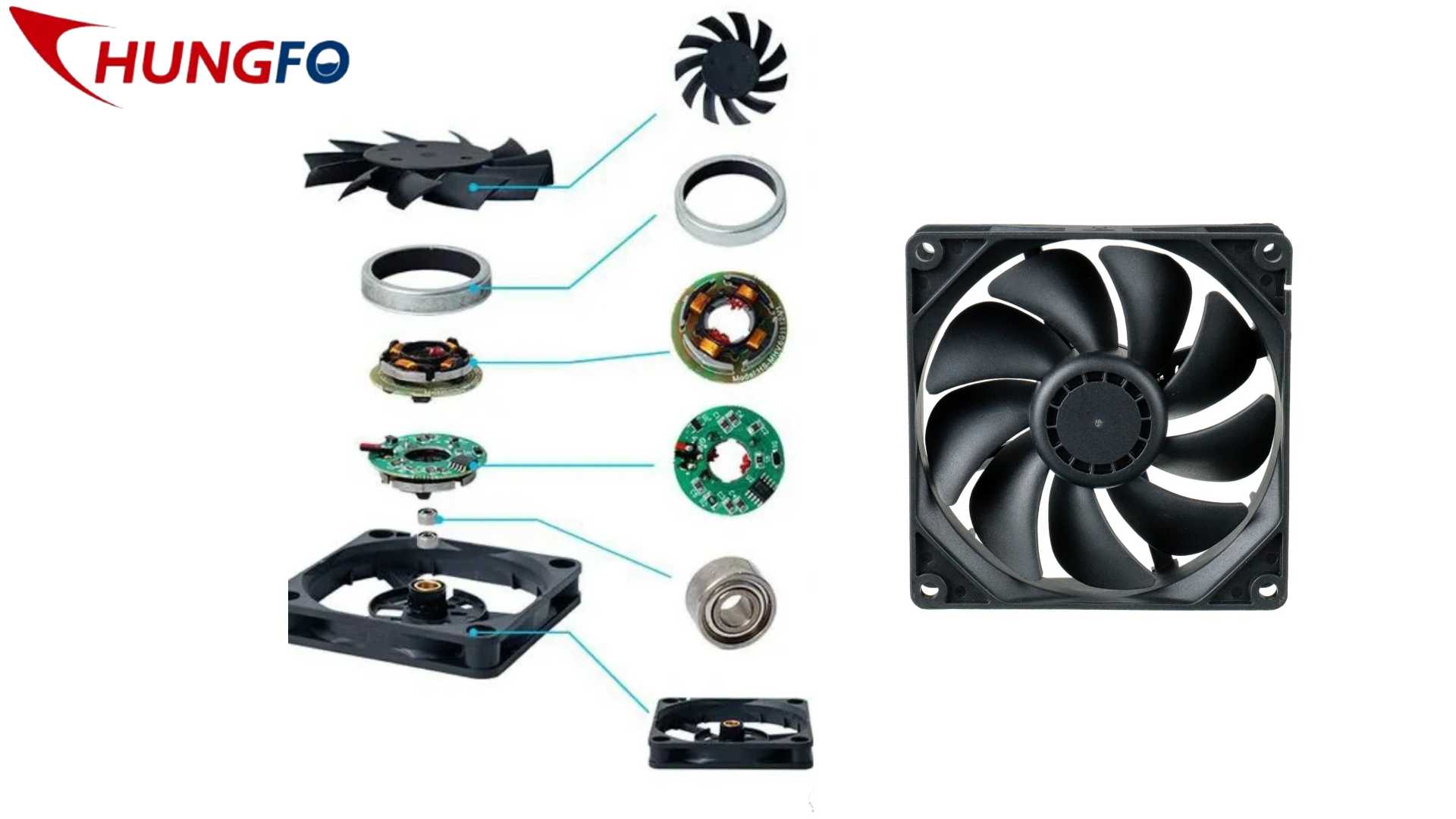
Le stator est la partie fixe du moteur et est responsable de la génération du champ électromagnétique qui entraîne le rotor.
L'ensemble stator comprend principalement des ressorts de support, des roulements, des anneaux de retenue et la structure du moteur.
Le ressort de support contribue à maintenir un espacement adéquat entre les composants internes et aide à stabiliser la position de l'arbre.
Les roulements assurent une rotation fluide et stable du rotor. Grâce à leur haute qualité, le ventilateur de refroidissement CC peut fonctionner à grande vitesse tout en garantissant un faible frottement et une longue durée de vie.
La bague de retenue maintient les composants rotatifs en place et assure le bon alignement de l'ensemble rotor.
Le noyau du moteur génère le champ électromagnétique qui détermine le sens et la vitesse de rotation.
Structure du cadre du ventilateur
Le cadre extérieur du ventilateur de refroidissement assure le support mécanique du moteur et guide le flux d'air à travers le ventilateur.
Le cadre du ventilateur remplit deux rôles importants. Premièrement, il maintient le moteur et le rotor en place. Deuxièmement, il contribue à diriger efficacement le flux d'air à travers le canal du ventilateur afin d'améliorer les performances de refroidissement.
Une conception de cadre appropriée peut améliorer considérablement l'efficacité du flux d'air et réduire le bruit aérodynamique.
Système de commande du moteur et électronique
Le système moteur est le composant principal qui entraîne un ventilateur de refroidissement CC sans balais.
Il comprend généralement une carte de circuit imprimé, des feuilles d'acier au silicium (noyau du stator) et des revêtements isolants.
La carte de circuit imprimé contrôle la consommation d'énergie et gère les signaux d'entrée et de sortie. Elle régule également la vitesse du moteur et la stabilité de son fonctionnement.
Les tôles d'acier au silicium, qui constituent le noyau magnétique du stator, sont enroulées de filaments de cuivre. Lorsqu'un courant électrique traverse ces filaments, un champ magnétique est généré, lequel interagit avec les aimants du rotor pour produire une rotation.
Les couvercles supérieur et inférieur de la structure du stator assurent l'isolation et la protection structurelle de l'ensemble moteur.
Paramètres de performance clés d'un ventilateur de refroidissement CC
Taille du ventilateur
La taille d'un ventilateur de refroidissement à courant continu est généralement exprimée par ses dimensions extérieures et son épaisseur. L'unité est le millimètre. Par exemple, un Ventilateur 4010 fait référence à un ventilateur mesurant 40 mm sur 40 mm avec une épaisseur de 10 mm.
Tension nominale
La tension nominale correspond à la tension de fonctionnement nécessaire au fonctionnement normal du ventilateur. Les spécifications de tension courantes pour les ventilateurs de refroidissement CC sans balais sont 5 V, 12 V, 24 V et 48 V.
Vitesse du ventilateur
La vitesse du ventilateur, exprimée en tours par minute (tr/min), indique sa rapidité de rotation. Une vitesse plus élevée génère généralement un débit d'air plus important. Les fabricants classent souvent la vitesse des ventilateurs en différents niveaux (ultra-élevée, élevée, moyenne et basse) afin de répondre aux exigences des différentes applications.
Flux d'air
Le débit d'air est un indicateur important de la capacité de refroidissement d'un ventilateur. Il est généralement mesuré en pieds cubes par minute (CFM). Dans certaines régions, il peut être exprimé en mètres cubes par minute (CMM), où 1 CMM équivaut à 35,31 CFM.
Pression statique
La pression statique représente la capacité du ventilateur à vaincre la résistance à l'écoulement de l'air. Elle influe directement sur les performances de ventilation et de dissipation de la chaleur. La pression statique est généralement mesurée en mm H₂O ou en inH₂O.
Niveau sonore
Le niveau sonore est un autre paramètre important lors de l'évaluation d'un ventilateur de refroidissement à courant continu. Bien qu'il n'affecte pas directement les performances de refroidissement, il joue un rôle important dans les environnements où un fonctionnement silencieux est requis. Les niveaux sonores sont généralement mesurés en décibels (dBA).
Système de roulement
Le système de roulement est considéré comme l'élément mécanique principal d'un ventilateur de refroidissement CC sans balais. Il détermine la durée de vie mécanique et la stabilité de fonctionnement du ventilateur. Les types les plus courants sont les roulements à billes et les paliers lisses.
Connecteurs de ventilateur
Les connecteurs de ventilateurs sont souvent négligés, mais ils sont essentiels à l'intégration du système. Les types de connecteurs courants comprennent les connecteurs à deux, trois et quatre broches, ainsi que les configurations à branchement direct et inverse.
Circuit électronique d'un ventilateur de refroidissement CC sans balais
Les micromoteurs à courant continu sont largement utilisés dans les appareils électroménagers et les équipements électroniques. Dans les ordinateurs, les ventilateurs de refroidissement à courant continu sont couramment utilisés pour dissiper la chaleur.
Un ventilateur de refroidissement CC sans balais utilise une structure de moteur sans balais qui élimine les inconvénients des moteurs à balais traditionnels, tels que l'usure mécanique, le bruit élevé et la courte durée de vie.
De nombreux circuits de ventilateurs sans balais sont basés sur des générateurs d'impulsions à capteur à effet Hall. Ces circuits sont de conception simple et offrent des performances stables.
Dans les systèmes électriques automobiles et industriels, les environnements électromagnétiques peuvent être complexes. Par conséquent, les ventilateurs de refroidissement doivent présenter une forte capacité d'immunité aux interférences.
Parce que Ventilateurs sans balais CC Fonctionnant sans balais mécaniques, ils génèrent un minimum d'interférences électromagnétiques et offrent une durée de vie mécanique supérieure à celle des moteurs à balais traditionnels. C'est pourquoi ils sont largement utilisés dans les applications nécessitant un refroidissement forcé fiable dans les équipements électroniques et électriques.