
Catégories
Nouveau blog
CFM vs RPM: Which Fan Specification Matters More?
October 23 , 20261. Quick Answer
When comparing CFM vs RPM, CFM is generally more useful for evaluating how much air a cooling fan can move, while RPM helps explain how fast the fan rotates and how its performance may change with speed. Neither specification should be used alone to determine whether a fan is suitable for an application.
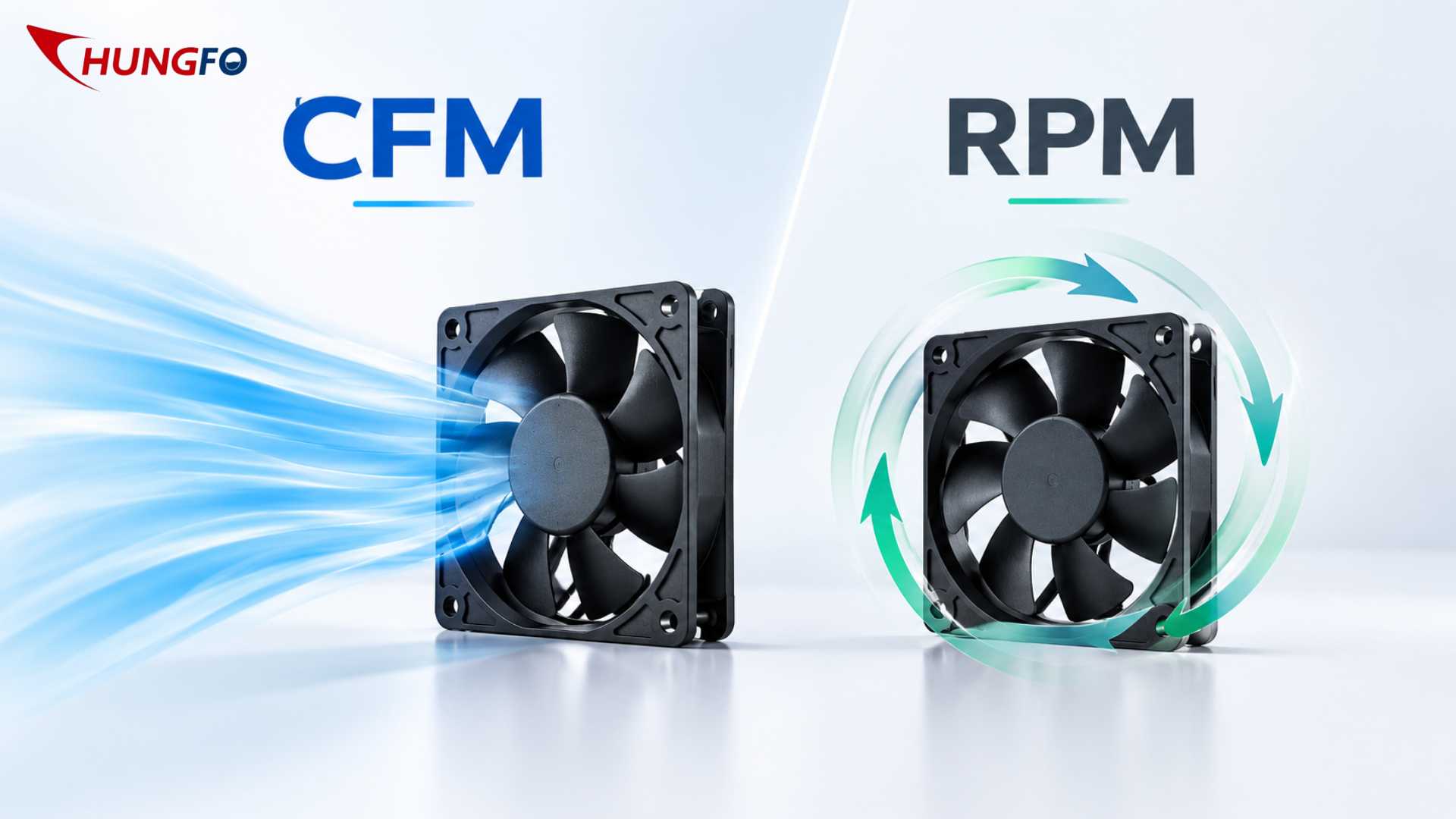
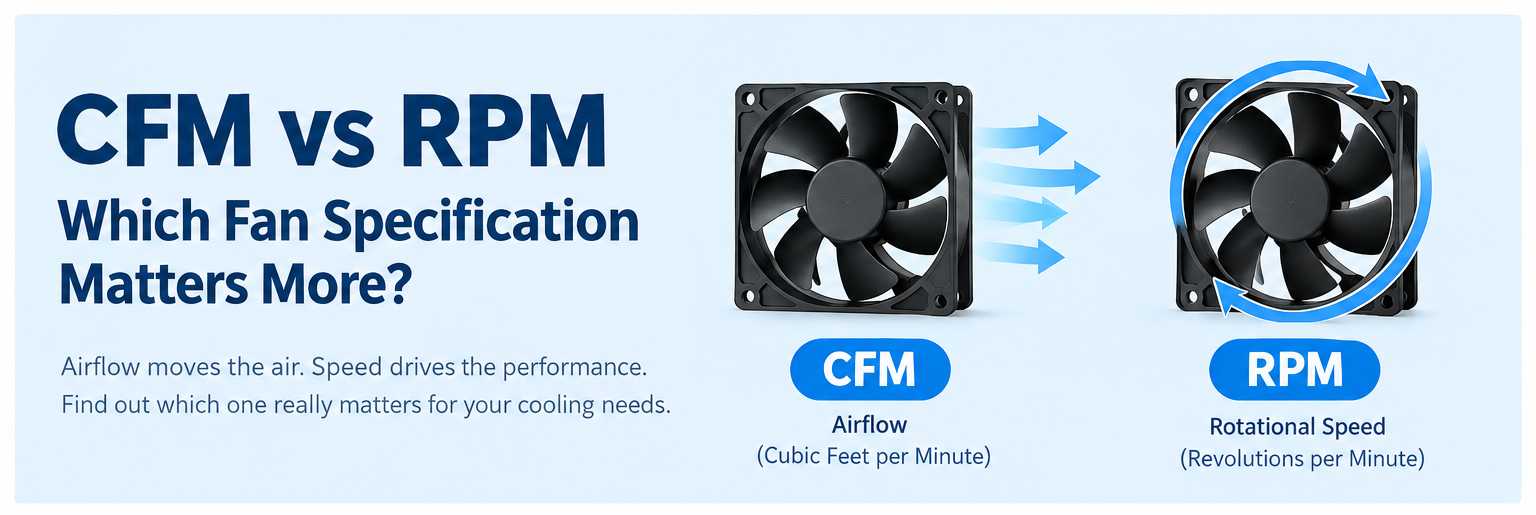
CFM stands for cubic feet per minute and measures volumetric airflow. RPM stands for revolutions per minute and measures rotational speed. A higher RPM can increase airflow when comparing the same fan under comparable conditions, but two fans operating at the same RPM can produce significantly different airflow because of differences in impeller geometry, blade pitch, frame dimensions, motor design, and aerodynamic efficiency.
For engineers and equipment manufacturers, the more important question is not simply which number is larger. It is whether the selected fan can deliver the required airflow against the resistance created by the actual equipment while meeting electrical, acoustic, dimensional, and reliability requirements.
For open enclosures with relatively little airflow restriction, CFM is often a useful starting point. For compact equipment containing heat sinks, filters, narrow ventilation channels, or dense internal components, static pressure and the fan's pressure-flow curve become equally important and may determine the final selection.
The most reliable selection method is to evaluate airflow, RPM, static pressure, voltage, current, power consumption, noise, and installation conditions together. This approach helps equipment manufacturers avoid choosing a fan that looks powerful on a specification sheet but performs poorly after installation.
2. Key Takeaways
CFM measures the volume of air moved per minute, whereas RPM measures the rotational speed of the impeller. These specifications describe different aspects of fan performance and cannot be directly substituted for one another.
Higher RPM does not automatically mean better cooling. Fan geometry, motor characteristics, static pressure, airflow resistance, and noise requirements all influence the result.
Maximum airflow is commonly measured under free-air conditions. Once a fan is installed behind a grille, filter, heat sink, or narrow duct, the actual airflow can be lower than the catalog maximum.
Static pressure indicates a fan's ability to overcome airflow resistance. It is particularly important in compact electronic equipment, densely packed enclosures, and applications with restrictive ventilation paths.
For the same fan under comparable operating conditions, airflow approximately follows rotational speed, static pressure approximately follows the square of rotational speed, and shaft power approximately follows the cube of rotational speed. These relationships are engineering approximations rather than guarantees of installed performance.
A 12V or 24V rating identifies the intended DC supply voltage, not the fan's airflow or cooling capacity. A cooling fan 12v dc model and a cooling fan 24v dc model must be compared using their actual performance data rather than voltage alone.
The best fan is the one that meets the application's airflow and pressure requirements at an acceptable noise level, power consumption, operating temperature, and service life.
3. What Does CFM Mean in Fan Specifications?
CFM means cubic feet per minute. It is a volumetric airflow measurement indicating how much air passes through a fan in one minute. In cooling applications, airflow helps transport heat away from electronic components, motors, power supplies, and other heat-generating parts.
A fan with sufficient airflow can help prevent heat accumulation, improve temperature uniformity, and support the stable operation of equipment. However, the usefulness of a CFM rating depends on the conditions under which it was measured.
3.1 Why Airflow Matters
Heat generated by an electronic component must be transferred away through conduction, convection, radiation, or a combination of these mechanisms. In many compact devices, forced convection is an important part of the thermal management strategy.
A fan moves air across a heat-generating surface. The moving air absorbs some of the heat and carries it toward an exhaust opening or another part of the cooling system.
When the airflow is insufficient, the air near hot components can become warmer, reducing the temperature difference that drives convective heat transfer. This can contribute to higher component temperatures, thermal throttling, reduced efficiency, or premature failure.
Increasing airflow may improve heat removal, but only when the air reaches the areas that need cooling. A fan with a high free-air CFM rating may not perform well if the air bypasses the heat sink or cannot pass through a restrictive internal structure.
Consequently, engineers should evaluate not only the total airflow but also the direction, distribution, and effectiveness of the airflow within the equipment.
3.2 What Does a Higher CFM Rating Tell You?
A higher CFM rating generally indicates a greater maximum volumetric airflow under the specified test conditions. This can be useful when comparing fans intended for similar installations.
For example, an open electronic enclosure may benefit from a fan that exchanges internal air efficiently. A larger volume of air passing through the enclosure can help carry heat away from multiple components.
Nevertheless, a catalog maximum does not necessarily represent the airflow available in the finished product. The result changes when the fan encounters resistance from filters, protective grilles, cables, heat sinks, ducts, or small ventilation openings.
The relevant specification is therefore the airflow delivered at the pressure required by the application, rather than the highest free-air number in the product listing.
3.3 Common Units Used to Express Airflow
CFM is widely used in North American product specifications. Other common units include cubic metres per hour, cubic metres per minute, and litres per second.
One CFM is approximately 1.699 cubic metres per hour. This conversion helps engineers compare specifications published in different measurement systems.
However, unit conversion does not eliminate differences in testing conditions. Two fans rated in different units should still be compared at equivalent pressure conditions and under comparable test procedures.
3.4 When CFM Should Be a Primary Selection Factor
CFM is particularly useful when the design requires a defined volume of air to enter, circulate through, or leave an enclosure.
Typical examples include open equipment cabinets, ventilation compartments, electronic housings with relatively unobstructed airflow paths, and some household appliances.
In these applications, engineers should estimate the required airflow from the thermal load, allowable temperature rise, air distribution, and equipment layout.
The required airflow should then be checked against the fan's performance curve. A fan with a higher nominal CFM may be appropriate, but only if it can deliver the required volume under the actual operating conditions.
4. What Does RPM Mean in Fan Specifications?
RPM means revolutions per minute. It indicates how many complete rotations the fan's impeller makes in one minute.
RPM is an important operating parameter because rotational speed affects the fan's aerodynamic performance. For the same fan, increasing speed generally increases airflow and pressure capability, although the actual result depends on the system resistance and operating conditions.
4.1 Why Fan Speed Matters
The impeller transfers energy to the air as it rotates. Blade shape, blade angle, diameter, frame geometry, and motor performance determine how effectively that energy becomes useful airflow and pressure.
When the rotational speed increases, the fan can generally move more air and develop greater pressure. This can help maintain cooling performance in applications where airflow resistance is significant.
However, increasing speed may also increase aerodynamic noise, motor noise, vibration, electrical consumption, and mechanical stress. The increase in noise depends on fan design and installation conditions, so RPM alone cannot predict the sound level.
A fan operating at a high speed may also require a suitable motor, bearing system, structural design, and control strategy. Its operating point must remain within the manufacturer's specified limits.
4.2 Why the Same RPM Does Not Mean the Same CFM
Consider two fans operating at 4,000 RPM. One may have a larger impeller, more effective blade geometry, or a housing designed to reduce aerodynamic losses. The other may have a smaller impeller or a design optimized for a different pressure range.
Even though their rotational speeds are identical, their airflow and static pressure can differ considerably.
The same principle applies when comparing axial fans and centrifugal blowers. These fan types use different airflow paths and aerodynamic designs. Their RPM figures cannot be used as a universal basis for comparing cooling performance.
For procurement teams, RPM is most useful when considered alongside CFM, static pressure, noise, power consumption, fan dimensions, and the intended installation.
4.3 RPM and Speed Control
Some DC fans support speed control through pulse-width modulation, commonly called PWM, or other manufacturer-specific control methods. Depending on the design, the control system can adjust rotational speed in response to temperature or operating demand.
For example, equipment may operate at a lower fan speed when internal temperatures are moderate and increase speed when the thermal load rises.
This approach can help balance cooling performance, energy consumption, and noise. However, the control interface, minimum operating speed, startup behaviour, tachometer feedback, and electrical requirements must be verified for the selected model.
Not every DC fan supports the same control functions. Engineers should check the manufacturer's datasheet before designing a speed-control circuit.
5. CFM vs RPM: The Key Differences
The most important distinction is that CFM describes airflow output, whereas RPM describes rotational speed. One is a measure of the air moved; the other is a measure of how fast the impeller turns.
5.1 Specification Comparison
Specification: CFM
Meaning: Volumetric airflow per minute.
Common use: Estimating the air volume available for ventilation and cooling.
Main limitation: The published maximum may be measured under free-air conditions and may not reflect installed airflow.
Specification: RPM
Meaning: Impeller revolutions per minute.
Common use: Understanding operating speed, speed-control behaviour, and changes in fan performance.
Main limitation: It does not directly indicate airflow, static pressure, or cooling effectiveness.
Specification: Static pressure
Meaning: The pressure a fan develops to overcome resistance in the airflow path.
Common use: Selecting fans for heat sinks, filters, narrow passages, ducts, and restrictive enclosures.
Main limitation: Maximum static pressure alone does not indicate how much airflow the fan delivers at the required operating point.
Specification: Power consumption
Meaning: The electrical power required during operation.
Common use: Checking power-supply capacity, operating costs, and thermal constraints.
Main limitation: Voltage and current ratings alone may not reveal actual power consumption across all operating conditions.
Specification: Noise
Meaning: The acoustic output under specified measurement conditions.
Common use: Applications with noise limits, including office equipment, household appliances, and medical devices.
Main limitation: Published sound levels are meaningful only when measurement conditions and installation environments are comparable.
5.2 Which Specification Should You Check First?
Start with the cooling requirement rather than the largest number on the datasheet.
If the equipment requires a particular volume of air to be exchanged, determine the target airflow. Then estimate the resistance created by the airflow path and identify the pressure required at that airflow.
Next, evaluate the fan curve to establish whether the candidate fan can deliver the target performance. RPM helps explain the operating conditions under which that performance is achieved, while electrical and acoustic specifications determine whether the solution is practical.
For many compact electronic applications, the complete pressure-flow relationship is more informative than either maximum CFM or maximum RPM in isolation.
6. Why Static Pressure Changes the CFM vs RPM Decision
Airflow resistance is one of the main reasons that fan selection based on CFM and RPM alone can produce disappointing results.
When air moves through a system, components such as filters, grilles, heat sinks, ducts, and bends create pressure losses. The fan must generate enough pressure to overcome these losses while still delivering the required airflow.
6.1 Understanding the Pressure-Flow Curve
A pressure-flow curve, often called a P-Q curve, shows the relationship between airflow and pressure for a particular fan under defined operating conditions.
For many conventional fans, maximum free-air airflow occurs near the low-pressure end of the curve. Maximum static pressure occurs near the zero-flow end. These are different operating conditions and should not be interpreted as simultaneous performance values.
The actual operating point is determined by the intersection of the fan's performance curve and the resistance curve of the installed system.
This explains why a fan advertised with a high maximum CFM may deliver substantially less airflow after installation. The fan is no longer operating under free-air conditions.
6.2 Open Airflow Paths
When the air path is relatively open, system resistance is comparatively low. In this situation, maximum airflow and the fan's ability to circulate air effectively may receive greater attention.
Examples include equipment enclosures with large ventilation openings and installations where the fan is not positioned behind a dense filter or tightly packed heat sink.
CFM is a useful initial comparison metric in these situations. However, engineers must still confirm the actual operating point, noise level, and cooling distribution.
6.3 Restricted Airflow Paths
When air must pass through narrow vents, dense filters, compact heat sinks, or complicated internal channels, static pressure becomes especially important.
A fan with a high free-air CFM rating may lose a large proportion of its airflow under these conditions. Another fan with a different aerodynamic design may deliver more useful airflow against the same resistance.
In these applications, compare the full pressure-flow curves and identify the airflow available at the required pressure. Do not assume that the fan with the highest RPM or maximum CFM will perform best.
7. How RPM Affects Airflow, Pressure, and Power
For the same fan operating under comparable conditions, engineers commonly use fan affinity laws to estimate how performance changes with rotational speed.
The approximate relationships are:
Airflow ratio = New RPM / Original RPM
Pressure ratio = (New RPM / Original RPM)²
Shaft power ratio = (New RPM / Original RPM)³
These equations provide preliminary estimates when the fan geometry remains unchanged and the operating conditions are sufficiently comparable. They should not replace manufacturer performance data or testing in the actual equipment.
7.1 A Practical RPM Calculation
Suppose a fan delivers 20 CFM at 3,000 RPM under a defined test condition. If its speed increases to 3,600 RPM, the speed ratio is 1.2.
The estimated airflow under the simplified fan-law assumption is:
20 × 1.2 = 24 CFM.
The estimated pressure capability would increase by a factor of 1.2², or 1.44. The corresponding shaft-power requirement would increase by a factor of 1.2³, or 1.728.
These calculations demonstrate why a modest speed increase can have a larger effect on pressure and power than on airflow.
The estimated values are not guaranteed measurements. Actual airflow depends on the system resistance, motor characteristics, aerodynamic design, air density, and the fan's permitted operating range.
7.2 Why Increasing RPM Is Not Always the Best Solution
If an installed fan cannot deliver sufficient airflow, increasing speed may be one possible response, provided the fan supports it and the motor remains within its operating limits.
However, the underlying restriction may be caused by an undersized vent, an excessively dense filter, a poorly positioned heat sink, or an inefficient airflow path. Increasing RPM does not remove these restrictions.
It may instead increase noise and electrical consumption without delivering the expected cooling improvement.
Before changing speed, engineers should inspect the complete airflow path and confirm that the fan's pressure-flow curve matches the application.
8. How to Select the Right DC Cooling Fan
Selecting a DC fan requires more than choosing a voltage and comparing two headline performance figures. A suitable selection process considers the mechanical installation, thermal load, pressure losses, electrical supply, noise target, and expected operating environment.
8.1 Define the Cooling Requirement
Identify which components generate heat, their allowable operating temperatures, the expected ambient temperature, and the maximum permissible temperature rise.
Estimate the heat that must be removed and determine whether the design requires fresh-air exchange, direct airflow across a heat sink, or circulation within an enclosure.
The thermal calculation provides a starting point for estimating airflow demand. The final requirement should account for uneven air distribution, heat transfer limitations, and the actual geometry of the equipment.
8.2 Measure the Available Space
Confirm the fan's width, height, thickness, mounting-hole pattern, connector position, and clearance around the inlet and outlet.
A fan that fits the external dimensions may still perform poorly if nearby components block the inlet or exhaust. The design should provide sufficient clearance and avoid abrupt changes in the airflow path where practical.
8.3 Confirm the Required Static Pressure
List the major sources of resistance, including filters, protective guards, heat sinks, ducts, and narrow openings.
If the equipment has a complex airflow path, estimate or measure the pressure losses. Use the fan curve to identify a model capable of supplying the required airflow at that pressure.
This step is especially important when choosing a fan for compact equipment, where installation restrictions can strongly influence performance.
8.4 Check Voltage, Current, and Power
The rated voltage must match the available DC power supply and the manufacturer's operating requirements.
A cooling fan 12v dc model is designed for a nominal 12V DC supply, while a cooling fan 24v dc model is intended for a nominal 24V DC supply. The correct choice depends on the equipment's electrical architecture and the selected fan's specifications.
Do not assume that a 24V fan automatically produces more airflow than a 12V fan. Voltage alone does not determine performance. Different models may have different motors, impellers, rated speeds, current requirements, and pressure characteristics.
Confirm startup current, rated current, maximum power, polarity, connector pinout, and any speed-control requirements before integrating the fan.
8.5 Evaluate Noise and Reliability
Consider the acceptable sound level, bearing design, expected operating hours, ambient temperature, dust exposure, vibration, and maintenance requirements.
Noise should be evaluated at the actual operating speed and installation condition whenever possible. A fan that meets the airflow requirement at a lower speed may offer a better balance than one that must operate continuously at maximum speed.
Reliability also depends on the motor, bearings, materials, manufacturing consistency, and suitability for the operating environment. Datasheet claims should be verified against the intended duty cycle and applicable qualification requirements.
9. Choosing Between 12V and 24V DC Fans
The decision between 12V and 24V DC fans should begin with the equipment's power architecture rather than an assumption that one voltage is inherently better.
9.1 When a 12V DC Fan Is Suitable
A 12V DC fan may be appropriate for equipment designed around a 12V power rail, including various electronic devices, small appliances, compact cooling assemblies, and selected vehicle-related applications.
A dc 12v cooling fan can be attractive when the system already provides a compatible 12V supply and the fan's dimensions, airflow, pressure, noise, and current consumption satisfy the design requirements.
However, 12V compatibility does not guarantee that the fan will start reliably or deliver the required airflow. Engineers must check the actual voltage range, startup behaviour, and performance data.
9.2 When a 24V DC Fan Is Suitable
A 24V DC fan may be suitable for equipment whose electrical system is designed around a 24V supply. This can include industrial control equipment, certain power systems, automation assemblies, and other products using 24V DC distribution.
The primary advantage is electrical compatibility with the system, not an automatic increase in cooling capacity.
A 24V model should be selected by comparing its rated performance and electrical characteristics with the 12V alternatives. If the two models have different impellers or motor designs, their CFM and RPM ratings may differ for reasons unrelated to nominal voltage alone.
9.3 Can a 12V Fan Replace a 24V Fan?
Not automatically. The replacement must satisfy the required voltage, connector, polarity, control interface, mounting dimensions, airflow, static pressure, and environmental conditions.
Operating a 12V fan from an unsuitable 24V supply may damage the motor or control electronics unless the fan is explicitly rated for that input. Similarly, a 24V fan connected to a 12V source may fail to start or may operate outside its intended performance range.
Use the manufacturer's electrical specifications and, when necessary, an appropriate regulated power supply or conversion circuit.
10. Application-Based Selection: Which Matters More?
The relative importance of CFM and RPM changes with the application. Engineers should begin with the equipment's actual cooling problem and then identify which specifications govern the solution.
10.1 Electronic Enclosures
Electronic enclosures often contain several heat-generating components. The required airflow depends on total heat dissipation, internal layout, and the temperature difference between incoming air and the enclosure.
CFM helps establish whether the fan can exchange sufficient air. Static pressure determines how much of that airflow remains available after accounting for filters, grilles, and internal obstructions.
RPM is useful for assessing operating speed and control range, but it should not replace airflow and pressure measurements.
10.2 Power Supplies and Control Cabinets
Power supplies and control cabinets may contain transformers, switching components, heat sinks, and closely spaced electronic modules.
The fan must move air through the regions where heat accumulates. A high CFM rating is not enough if the airflow follows a path that bypasses critical components.
Engineers should consider inlet placement, exhaust placement, pressure losses, temperature distribution, and noise. Testing the assembled cabinet can reveal dead zones and recirculation that are not apparent from the fan datasheet.
10.3 Household Appliances
Household appliances may have limited installation space and specific noise requirements. The fan may operate near filters, ducts, plastic housings, or other components that change airflow resistance.
In this environment, the best selection balances useful airflow, pressure capability, electrical compatibility, and acoustic performance.
A fan that operates efficiently at a moderate RPM may be preferable to a faster model if both meet the cooling requirement and the lower-speed model produces less noise.
10.4 Medical and Laboratory Equipment
Medical and laboratory equipment may require stable temperature control, predictable airflow distribution, and carefully managed acoustic output.
The fan should be selected according to the equipment's validated thermal requirements and applicable product standards. Depending on the application, engineers may also need to evaluate cleanability, vibration, redundancy, airflow monitoring, and fault detection.
A nominal CFM rating cannot establish suitability for a particular medical or laboratory application without evaluating the complete system and relevant qualification requirements.
10.5 Compact Devices and Miniature Cooling Systems
Small devices have limited space for airflow channels and heat sinks. Even a small obstruction can significantly affect the available airflow.
In these applications, fan dimensions, blade geometry, pressure-flow performance, and mounting clearance can matter as much as the nominal airflow figure.
A compact fan should be tested in the intended enclosure rather than selected solely by its rated RPM. This is particularly important when the device has a narrow exhaust opening or several closely spaced components.
11. Common Mistakes When Comparing CFM and RPM
11.1 Choosing the Highest RPM
A higher RPM can indicate a faster fan, but it does not establish that the fan will deliver more useful airflow than another model. Differences in fan size, blade design, and pressure capability can change the outcome.
11.2 Treating Maximum CFM as Installed Airflow
Maximum CFM is often measured under conditions with little external resistance. Filters, grilles, heat sinks, and ducts reduce the airflow available in the finished product.
11.3 Ignoring Static Pressure
A fan may appear suitable based on its free-air rating but fail to deliver the required airflow through a restrictive installation. Engineers should review the pressure-flow curve and determine the actual operating point.
11.4 Comparing Different Fan Types by RPM Alone
Axial fans, centrifugal blowers, and cross-flow fans have different aerodynamic characteristics. Similar RPM values do not imply equivalent airflow or pressure performance.
11.5 Ignoring Noise and Power Consumption
Increasing speed may improve airflow, but it can also increase noise and power demand. The design should meet the cooling requirement without exceeding electrical or acoustic limits.
11.6 Assuming Voltage Determines Cooling Capacity
A 12V fan and a 24V fan cannot be ranked by nominal voltage alone. The actual motor, impeller, frame, and performance curve determine the result.
11.7 Failing to Test the Finished Product
A fan tested in isolation may perform differently when installed in an enclosure. Prototype testing should reproduce the intended airflow path, component placement, filter condition, and operating temperature as closely as practical.
12. A Practical Fan Selection Checklist
Before choosing a fan, confirm the following information.
First, identify the heat load and allowable temperature rise. Determine which components need direct cooling and how air should move through the enclosure.
Second, estimate the required airflow and identify the sources of pressure loss. Include filters, heat sinks, grilles, ducts, bends, and narrow openings.
Third, compare the candidate fans' CFM ratings, RPM ranges, pressure-flow curves, and acoustic characteristics.
Fourth, verify the nominal voltage, permitted voltage range, rated current, startup current, power consumption, connector, and speed-control interface.
Fifth, confirm the mechanical dimensions, mounting pattern, inlet clearance, exhaust clearance, and airflow direction.
Sixth, review the operating temperature, humidity, dust exposure, vibration, bearing requirements, expected service life, and relevant product certifications.
Finally, test the fan in the assembled equipment. Measure airflow and component temperatures under representative conditions, and evaluate noise, power consumption, and startup reliability.
This process provides a more dependable basis for selection than comparing maximum CFM or RPM alone.
13. How China Chungfo Fan Supports Cooling Fan Selection
China Chungfo Fan provides cooling fan and motor solutions for equipment manufacturers that need to balance airflow, pressure, dimensions, electrical characteristics, and operating requirements.
Its product categories include DC fans, AC fans, blowers, cross-flow fans, and related motor solutions for different equipment structures and cooling applications.
For OEM and customized projects, fan selection should begin with the customer's actual requirements rather than a generic model recommendation. Relevant information includes the installation dimensions, nominal voltage, airflow target, required static pressure, permissible noise level, current limit, operating temperature, and intended duty cycle.
Sharing these details helps the engineering team evaluate whether an existing model is suitable or whether further customization and validation may be necessary.
Product documentation and applicable certifications should also be checked against the target market and the finished equipment's compliance requirements. Certification coverage can vary by product model, configuration, and intended use, so purchasers should verify the relevant documents for the exact model being considered.
The goal is to select a fan that delivers reliable cooling under real operating conditions rather than one that simply advertises the largest performance number.
14. Frequently Asked Questions
14.1 Is CFM or RPM More Important for a Cooling Fan?
CFM is generally the more direct measure of airflow, while RPM describes rotational speed. For practical selection, neither should be considered alone. The required airflow, static pressure, fan curve, noise, and power consumption determine whether the fan is suitable.
14.2 Does Higher RPM Always Mean Higher CFM?
No. For the same fan under comparable conditions, increasing RPM generally increases airflow. However, different fans can produce different CFM values at the same RPM because their impeller geometry, dimensions, motor characteristics, and aerodynamic designs differ.
14.3 Can a Fan With Lower CFM Provide Better Cooling?
Yes, in some applications. A fan with a lower maximum free-air CFM rating may deliver more useful airflow against the resistance created by a heat sink, filter, or narrow duct. The actual pressure-flow curve and thermal results determine performance.
14.4 What Is More Important: CFM or Static Pressure?
Neither is universally more important. CFM measures airflow, while static pressure indicates the ability to overcome resistance. Open installations may place greater emphasis on airflow, whereas restrictive systems require careful evaluation of pressure capability and airflow at the operating point.
14.5 How Do I Compare 12V and 24V DC Fans?
Start with the equipment's available supply voltage, then compare the fan models' CFM, RPM, static pressure, current, power consumption, noise, dimensions, and control functions. Nominal voltage alone does not determine cooling capacity.
14.6 How Much CFM Do I Need for My Equipment?
The answer depends on the heat load, acceptable temperature rise, ambient conditions, airflow distribution, and system resistance. A preliminary thermal calculation can estimate airflow demand, but the final selection should be validated using fan performance data and testing in the actual equipment.
14.7 Why Is My Fan Delivering Less Airflow Than the Datasheet Indicates?
The installed equipment may create additional resistance through filters, heat sinks, grilles, narrow openings, or ducts. The published maximum CFM may also represent a free-air test rather than the operating condition in your product.
14.8 Can I Increase RPM to Improve Cooling?
Possibly, if the fan supports the higher speed and remains within its electrical and mechanical limits. However, increased RPM can raise noise and power consumption. Check the pressure-flow curve and investigate restrictions in the airflow path before changing the operating speed.
14.9 Does a Higher Voltage Mean a More Powerful Fan?
Not necessarily. A 24V fan is designed for a different nominal supply voltage than a 12V fan, but their airflow, pressure, speed, and power depend on the complete motor and impeller design. Compare actual datasheet values.
14.10 What Information Should I Send a Fan Manufacturer?
Provide the application, installation dimensions, supply voltage, target airflow, estimated static pressure, noise limit, operating temperature, available current, connector requirements, and expected operating hours. A drawing, photograph, or description of the airflow path can further improve the accuracy of the recommendation.
15. Conclusion: Select Performance, Not Just a Number
CFM and RPM are both useful fan specifications, but they answer different questions. CFM indicates how much air a fan can move under defined conditions. RPM indicates how fast its impeller rotates.
Neither number independently guarantees effective cooling. Static pressure, airflow resistance, motor characteristics, noise, electrical consumption, and installation geometry determine the performance that the equipment actually receives.
For a reliable selection, start with the thermal requirement, determine the required airflow and pressure, compare manufacturer performance curves, verify electrical compatibility, and test the fan in the finished product.
China Chungfo Fan can be considered as a source of DC fans, AC fans, blowers, cross-flow fans, and customized cooling solutions for different equipment applications. By providing clear technical requirements, equipment manufacturers can make more informed comparisons and identify fan models that suit their real operating conditions.
The most important specification is ultimately the one that helps the fan meet the equipment's actual cooling target reliably, efficiently, and within its design limits.