Catégories
Nouveau blog
Sélection des ventilateurs pour les équipements d'énergie renouvelable
February 11 , 2026Les équipements d'énergies renouvelables jouent un rôle essentiel dans les réseaux électriques modernes en permettant une production d'énergie propre et durable. Des applications telles que les onduleurs solaires, les convertisseurs éoliens, les systèmes de stockage d'énergie et les infrastructures de recharge fonctionnent dans des conditions électriques et environnementales exigeantes. Avec l'augmentation constante de la densité de puissance, un refroidissement efficace devient un facteur déterminant pour garantir la stabilité des performances et la fiabilité à long terme.
Le choix des ventilateurs pour les équipements d'énergies renouvelables requiert une approche différente de celle utilisée pour l'électronique conventionnelle. Les ingénieurs doivent prendre en compte non seulement le débit d'air et la pression, mais aussi l'adaptabilité environnementale, la fiabilité et la performance tout au long du cycle de vie. Cet article propose une vue d'ensemble systématique des principes de sélection des ventilateurs spécifiquement adaptés aux applications liées aux énergies renouvelables.
Caractéristiques thermiques des équipements d'énergie renouvelable
Les systèmes d'énergie renouvelable comportent généralement des étages de conversion de puissance élevés qui génèrent une chaleur importante. Des composants tels que les modules IGBT, les MOSFET, les transformateurs et les condensateurs sont très sensibles à l'élévation de température. Un refroidissement insuffisant peut réduire l'efficacité, accélérer le vieillissement et augmenter les taux de défaillance.
Contrairement aux appareils électroniques grand public, les équipements d'énergies renouvelables fonctionnent souvent en continu à des niveaux de charge élevés. Leur conception thermique doit donc privilégier une dissipation thermique constante plutôt que des performances de pointe ponctuelles. Le choix du ventilateur doit garantir un flux d'air stable sur de longues périodes de fonctionnement.
Défis environnementaux liés aux applications des énergies renouvelables
De nombreuses installations d'énergies renouvelables sont situées en extérieur ou dans des environnements semi-exposés. Les onduleurs solaires peuvent fonctionner dans des régions poussiéreuses et chaudes, tandis que les éoliennes sont souvent exposées à l'humidité, aux vibrations et aux embruns salés.
Ces facteurs environnementaux imposent des exigences supplémentaires aux ventilateurs de refroidissement. La tolérance à la température, la résistance à la corrosion, l'étanchéité et la stabilité aux vibrations sont autant d'éléments qui influencent le choix d'un ventilateur. Les ventilateurs standard pour intérieur peuvent ne pas résister à de telles conditions.
Détermination des besoins en débit d'air
Le calcul du débit d'air pour les équipements d'énergies renouvelables repose sur les mêmes principes thermiques fondamentaux que pour les autres systèmes, mais avec des marges de sécurité plus strictes. Les ingénieurs doivent calculer le débit d'air requis en fonction de la dissipation thermique totale, de l'élévation de température admissible et des conditions ambiantes les plus défavorables.
Les équipements d'énergie renouvelable fonctionnant souvent à des températures ambiantes élevées, les besoins en ventilation augmentent considérablement. Les ingénieurs doivent donc calculer le débit d'air en fonction de la température ambiante maximale prévue, et non dans des conditions nominales.
Conception du circuit de pression statique et d'écoulement d'air
Les équipements d'énergie renouvelable utilisent généralement des boîtiers compacts avec une forte densité de composants. Les dissipateurs thermiques, les filtres et les grilles de protection introduisent une résistance à l'écoulement de l'air qui augmente les exigences en matière de pression statique.
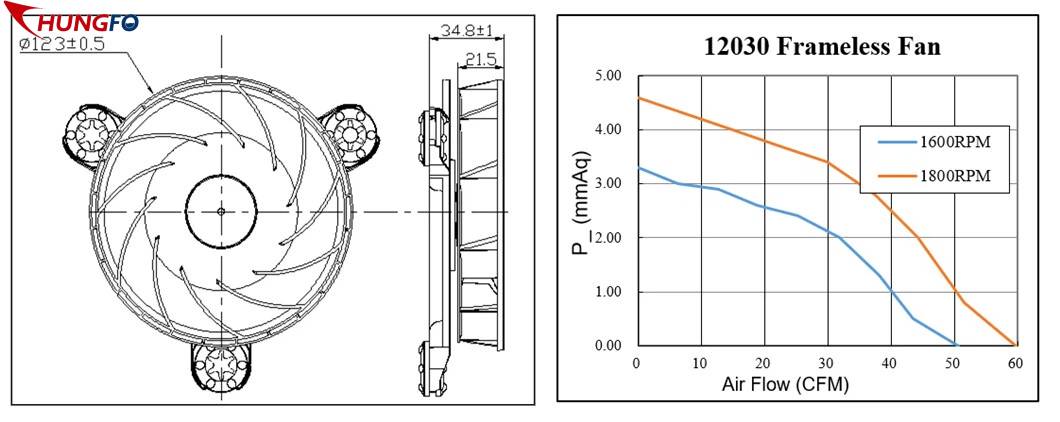
Le choix des ventilateurs doit tenir compte de l'impédance du système afin de garantir le débit d'air requis dans les conditions réelles d'utilisation. Choisir des ventilateurs uniquement en fonction de leur débit d'air libre peut entraîner un refroidissement insuffisant après leur installation.
Exigences en matière de fiabilité et de fonctionnement continu
La fiabilité est l'un des critères de sélection les plus importants pour les équipements d'énergies renouvelables. Les ventilateurs de refroidissement doivent fonctionner en continu pendant des années avec un minimum d'entretien.
La durée de vie nominale et la résistance thermique des roulements doivent être soigneusement évaluées. Les ventilateurs conçus pour un fonctionnement continu en milieu industriel offrent de meilleures performances à long terme et réduisent le risque d'arrêts imprévus.
Chine Chungfo Fan de DC soutient les applications en matière d'énergies renouvelables en proposant des produits conçus pour un fonctionnement stable sous charge continue et à températures élevées.
Considérations relatives au bruit et à l'efficacité
Bien que le bruit soit souvent moins critique dans les installations à grande échelle, il demeure un facteur important dans les systèmes d'énergie renouvelable résidentiels et commerciaux. Dans les installations solaires résidentielles, un bruit excessif des ventilateurs peut entraîner des plaintes de la part des clients.
Parallèlement, l'efficacité énergétique est une valeur fondamentale des systèmes d'énergies renouvelables. La consommation électrique des ventilateurs doit être minimisée sans compromettre les performances de refroidissement. Un contrôle optimisé de la vitesse des ventilateurs et une conception efficace du flux d'air permettent de concilier ces exigences.
Facteurs de protection et de sécurité
Ventilateurs de refroidissement Les équipements destinés aux énergies renouvelables doivent être conformes aux normes de sécurité et de protection. L'isolation électrique, la protection contre la poussière et l'humidité ainsi que la tolérance aux pannes sont essentielles.
Dans certaines applications, des mécanismes de détection et d'alarme des pannes de ventilateur sont nécessaires pour prévenir l'emballement thermique. L'intégration de fonctions de surveillance améliore la sécurité et la fiabilité du système.
Intégration à la stratégie de gestion thermique
Le choix du ventilateur doit s'intégrer à la stratégie globale de gestion thermique et non être considéré comme un choix de composant isolé. Les flux d'air, la conception du boîtier, l'orientation du dissipateur thermique et l'accessibilité pour la maintenance influent tous sur l'efficacité du refroidissement.
Une approche systémique permet aux ingénieurs d'optimiser les performances de refroidissement tout en maîtrisant les coûts et la complexité. Les ventilateurs China Chungfo privilégient la coordination entre leurs performances et la conception thermique du système afin de répondre aux exigences de fiabilité des énergies renouvelables.
Applications typiques des énergies renouvelables
Le choix approprié du ventilateur est essentiel dans de nombreux systèmes d'énergies renouvelables, notamment
Onduleurs solaires et optimiseurs de puissance
convertisseurs de puissance pour éoliennes
systèmes de stockage d'énergie et de gestion des batteries
équipement de recharge pour véhicules électriques
unités de contrôle d'énergie renouvelable hybrides
Dans toutes ces applications, une défaillance thermique peut compromettre la sécurité de la production d'énergie et la durée de vie du système.
Conclusion
Le choix des ventilateurs pour les équipements d'énergie renouvelable nécessite un équilibre délicat entre ventilateur à flux d'air Les ingénieurs doivent tenir compte des performances, de l'adaptabilité environnementale et de la fiabilité à long terme. Ils doivent notamment prendre en considération les conditions de fonctionnement difficiles, les cycles de service continus et les températures ambiantes élevées.
En appliquant des calculs systématiques de débit d'air, d'adaptation de la pression et d'évaluation de la fiabilité, les ingénieurs peuvent concevoir des solutions de refroidissement répondant aux exigences rigoureuses des systèmes d'énergies renouvelables. Le choix approprié des ventilateurs protège non seulement les équipements, mais contribue aussi directement à l'efficacité et à la durabilité des infrastructures d'énergie propre.